
Lake Ohrid, North Macedonia: The Complete Guide
Lake Ohrid, on the North Macedonia-Albania border: one of Europe's oldest and deepest lakes, a UNESCO site. Facts, both shores, beaches and how to visit.
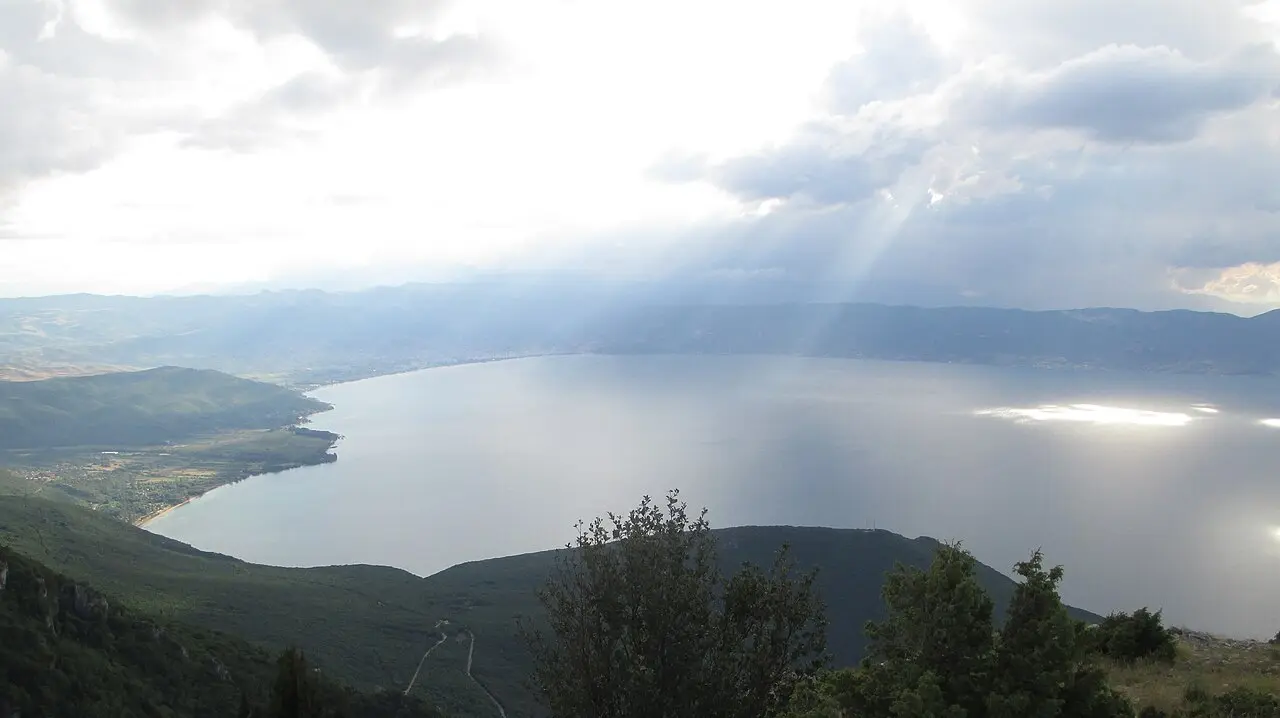
Lake Ohrid is the natural half of one of Europe’s great UNESCO World Heritage sites - a vast, deep-blue tectonic lake on the border between North Macedonia and Albania, and one of the oldest lakes on Earth. It has been filling its basin for somewhere between 1.2 and 1.4 million years, plunges to about 288 m deep, and shelters more than 200 species found nowhere else, from the famous Ohrid trout to ancient snails and sponges. For visitors that translates into clear swimming water, beaches strung along a wooded shore, the spring-fed monastery of St. Naum at the southern tip, and boat trips out over water so transparent you can watch the bottom drop away. This guide covers what makes the lake special, where to swim, the St. Naum springs, boat trips, the mountains around it, when to come, and how to get there. (For the lakeside town itself - its churches and fortress - see our separate guide to things to do in Ohrid.)
What is Lake Ohrid, and why is it UNESCO?
Lake Ohrid is a tectonic lake - it sits in a deep basin that opened up as the Earth’s crust pulled apart, which is why it’s so old and so deep rather than a shallow scrape left by ice. At roughly 358 km² of surface and about 288 m at its deepest point, it’s the deepest lake in the Balkans, and its great age makes it a living museum: isolated for over a million years, its waters evolved a cast of endemic species - more than 200 of them - that exist only here. The best known is the Ohrid trout (Salmo letnica), but the lake is just as prized by scientists for its endemic snails, worms and sponges. You won’t find that cast anywhere else.
That biological rarity is why the lake was added to the UNESCO World Heritage List. The Ohrid region is one of the few mixed sites in the world, recognised for both its natural value (the ancient lake and its species) and its cultural value (the Byzantine churches, monasteries and old town on the Macedonian shore). The listing dates to 1979-1980 and was extended across the border into Albania in 2019, so the protected area now covers both countries - and that’s what makes a two-shore trip feel like one place.
The lake also straddles an international border, which is part of what makes it interesting. Of its roughly 358 km² of surface, about 248 km² - two-thirds - lie in North Macedonia, with the remaining 110 km² or so in Albania; the whole thing sits just under 700 metres above sea level in a bowl of mountains. Much of its water arrives through underground karst springs, filtered down through the limestone from higher Lake Prespa to the east, and it drains out to the north at Struga, where the Black Drin river carries the outflow on through Albania toward the Adriatic. That slow, spring-fed turnover is a big part of why the water stays so startlingly clear - you’ll notice it the first time you lean over a jetty.
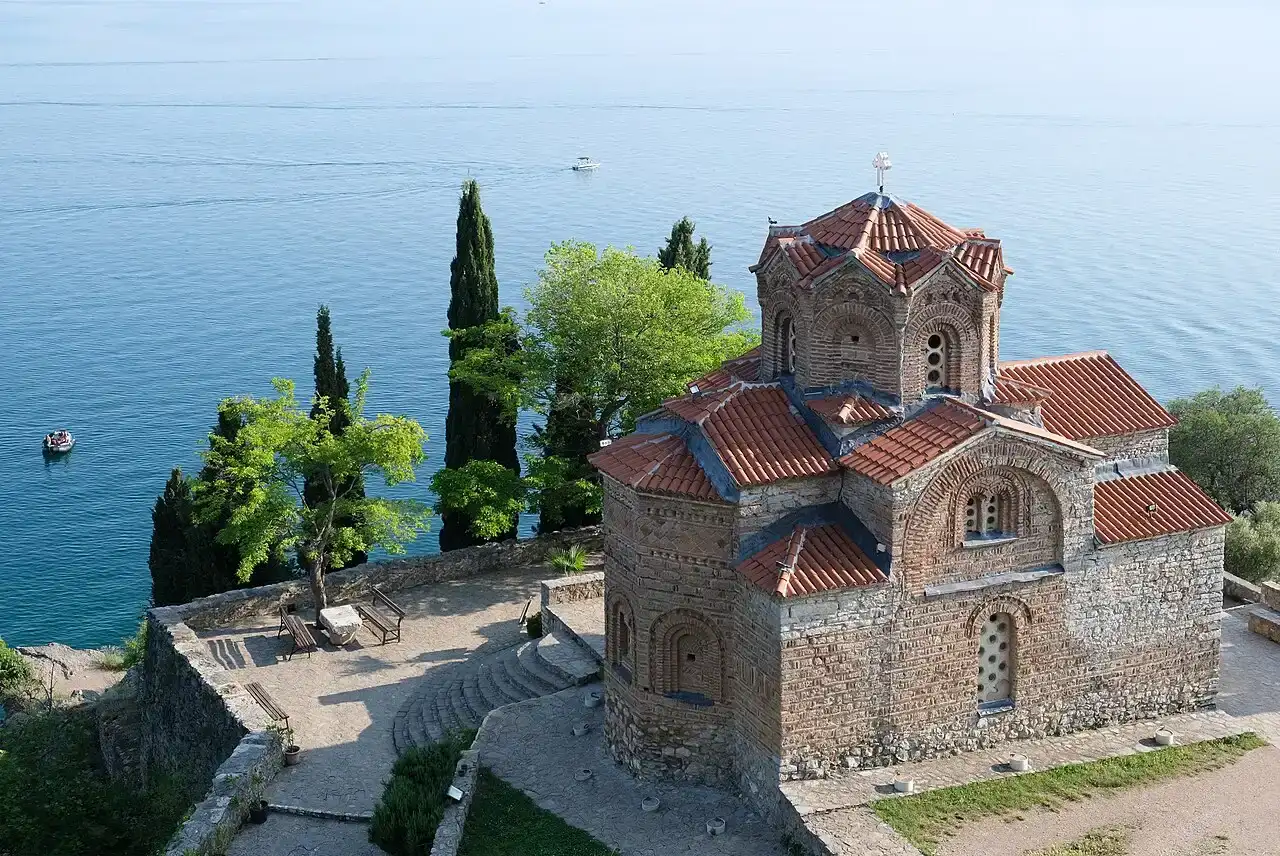
On the same headland, a short walk uphill from Kaneo, Plaošnik holds the reconstructed church of St Clement and early Christian mosaics - the cultural counterweight to Kaneo’s cliff-top view.
The lake is also the engine of the country’s tourism. The Ohrid municipality alone accounts for a large share of North Macedonia’s overnight stays, and the season is sharply summer-weighted - July and August are the peak, when the beaches and the lakeside promenade are at their busiest. Don’t expect empty sand then.
Beaches and swimming
The simple pleasure of Lake Ohrid is that you can swim in it. The water is fresh, clean and clear, and a string of beaches runs down the eastern shore between Ohrid town and the Albanian border in the south. They range from organised resort strands with sunbeds and bars to quiet pebble coves you reach by car or boat.
- Lagadin - the first of the bigger beaches heading south from Ohrid, a popular resort stretch with cafés, loungers and shallow entry, good for families.
- Gradište - a little further south, a larger beach-and-camping area that becomes one of the liveliest spots on the lake in high summer.
- Ljubaništa - close to St. Naum near the southern end, a long, calmer beach backed by trees, often the pick for a more relaxed day.
Town beaches along the Ohrid promenade are the easiest if you’ve no transport, but the cleaner, roomier swimming is out along this eastern shore. A car (or the seasonal lake bus and boats) makes the difference, since the best beaches are spread over 20-30 km of coast. For a full rundown - Lagadin, Gradište, Trpejca, the sandy St. Naum end and the town beaches, with how to reach each - see our guide to the best beaches on Lake Ohrid.
The lake warms slowly because it’s so deep, so the comfortable swimming window runs from roughly late June into September, with the warmest surface water in July and August (typically in the low-to-mid 20s °C). Spring and autumn are beautiful for walking the shore but cool for a long swim.
St. Naum: the monastery and the springs
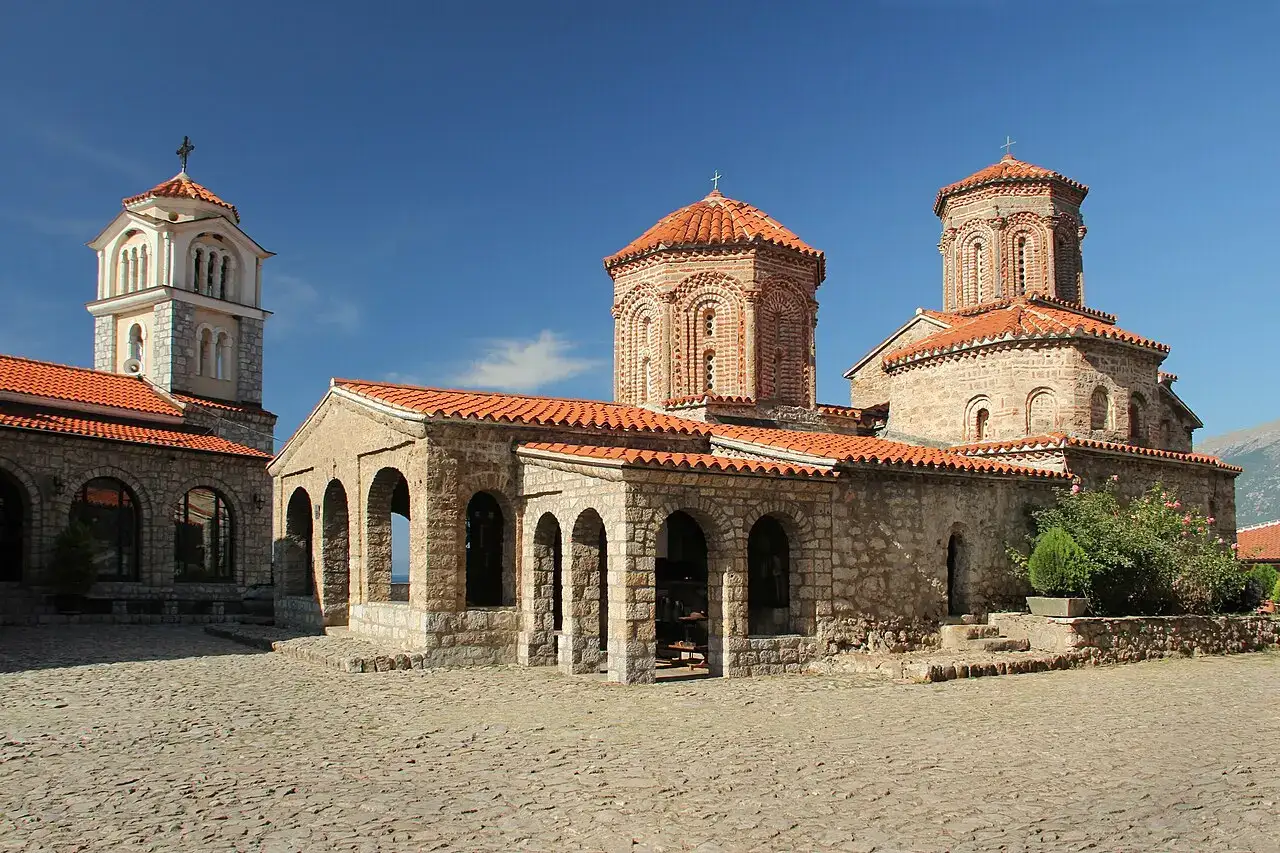
The set-piece at the southern end of the lake is the Monastery of St. Naum (Sveti Naum), founded around 905 AD by St. Naum of Ohrid - a disciple of Saints Cyril and Methodius and, with St. Clement, a founder of the Slavic literary tradition in the region. The domed stone church sits on a bluff right above the water, only a couple of kilometres from the Albanian border, and the grounds are famously patrolled by peacocks. It’s one of the most atmospheric spots on the whole lake. For the church interior, the tomb legend and how to get there overland, see our full guide to Sveti Naum monastery and springs.
Just below the monastery are the springs of St. Naum - a cluster of crystal-clear karst sources where cold underground water wells up to feed the lake. Small rowing boats run out across the glassy pools, where you can look straight down through the green water to the sandy bottom and the spots where the springs bubble up. It’s one of the lake’s signature short experiences, and an easy add-on to a visit to the monastery.
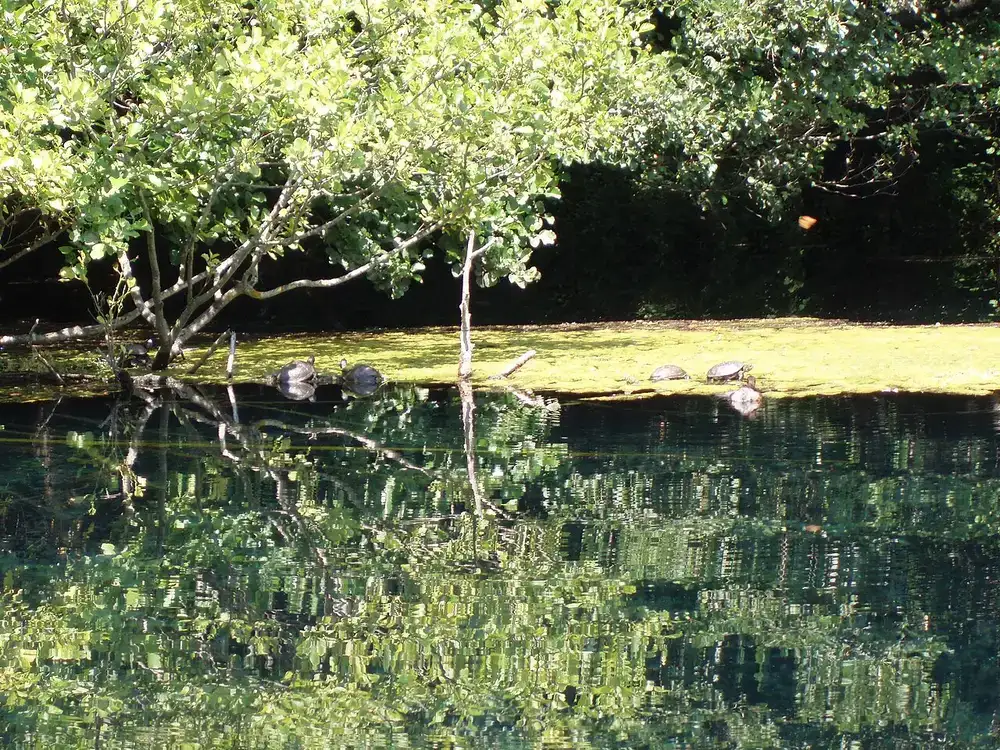
Boat trips on the lake
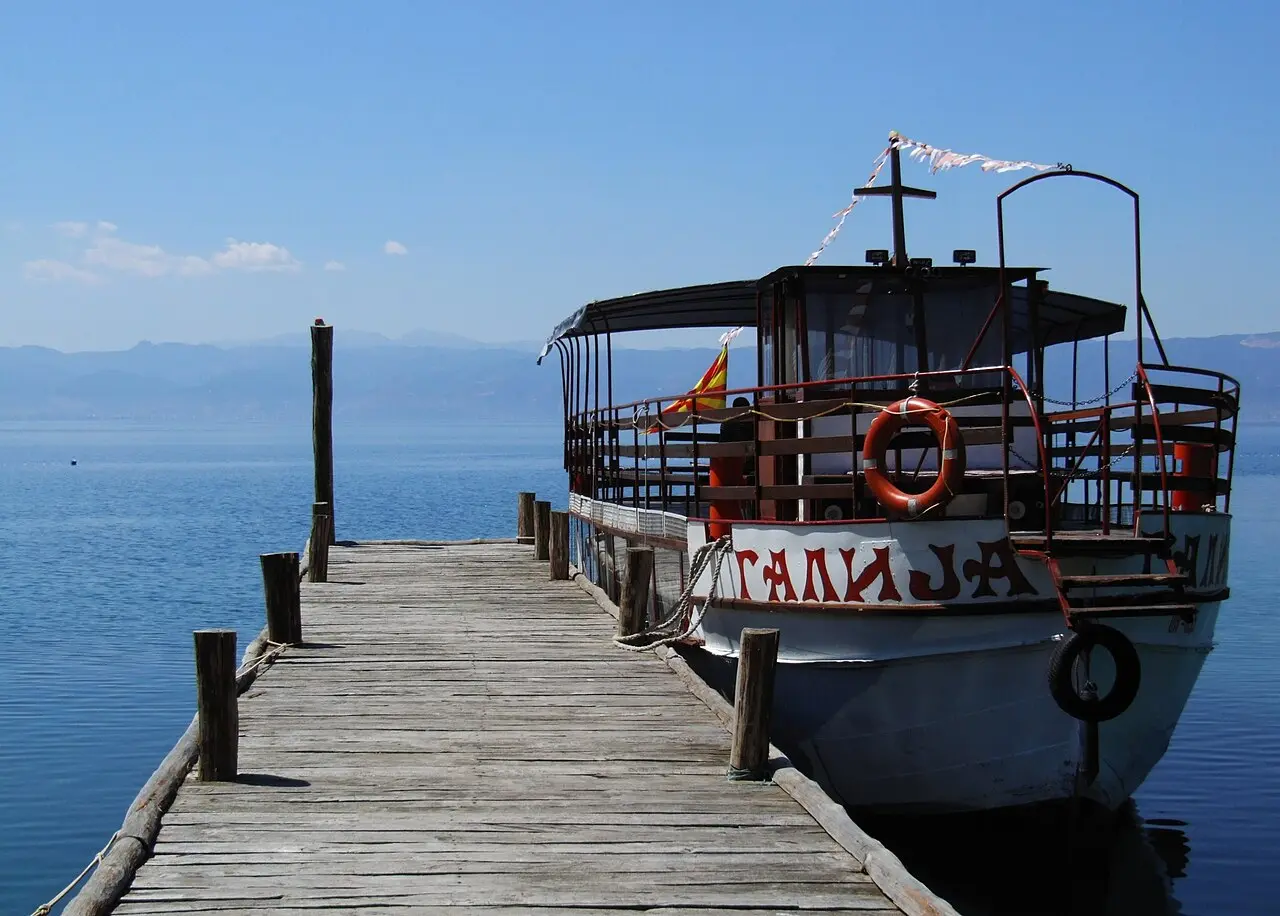
A boat trip is the classic way to feel the scale of Lake Ohrid. The headline excursion runs from Ohrid harbour south to St. Naum, roughly 29 km along the shore; the ride takes around an hour and a half each way, and the operators we checked leave Ohrid in the morning, between 09:40 and 10:30, with each one setting its own season (Armada takes online bookings May to September). Shorter hops cruise below the Church of St. John at Kaneo and around the bays near town, and you can also reach St. Naum overland by car or local bus and join a spring-boat there. For the full route, timings, the Bay of Bones stop and booking tips, see our guide to the Ohrid boat trip to Sveti Naum.
A worthwhile detour by boat or road is the Bay of Bones (Zaliv na Koskite), a reconstructed prehistoric pile-dwelling settlement built out over the water on the southern shore. The wooden houses on stilts recreate a Bronze- and Iron-Age lakeside village (roughly 1200-700 BC) found preserved on the lake bed, and there’s a small underwater-archaeology museum alongside it - a reminder that people have lived on this lake for several thousand years. See the full Bay of Bones guide for the archaeology, tickets and diving.
What’s around the lake
The lake doesn’t stand alone - it sits in a ring of mountains and shares its water with a neighbour, which is part of what makes a few days here so rewarding.
- Ohrid town. The cultural heart of the listing climbs the headland on the northeastern shore: Byzantine churches, an Ottoman-era old quarter, an ancient theatre and a hilltop fortress. It’s the obvious base - full details in our things to do in Ohrid guide.
- Galičica National Park. The mountain wall east of the lake is a national park, with a panoramic road climbing over the ridge that separates Lake Ohrid from Lake Prespa - a higher, quieter lake whose water actually seeps back through the limestone to feed Ohrid’s springs. The viewpoints from the top - like the one in the photo at the head of this guide - give you both lakes at a glance, and the park has hiking trails and rich wildlife.
- The Albanian shore. The southwestern third of the lake is in Albania, and it’s an easy hop: the lakeside town of Pogradec is only about 40 km from Ohrid, and the peninsula village of Lin, with its hilltop early-Christian mosaics, and the spring-fed park at Drilon near Tushemisht are worth crossing for. Since the 2019 UNESCO extension folded the Albanian side into the same World Heritage property, the whole lake is protected as one - and it’s close enough for a two-country loop by car.
This cross-border angle is built into our wider routes: the lake anchors the southern leg of the classic 7-day North Macedonia itinerary, and pairs naturally with a hop into Albania. To drive the shore in full, our Lake Ohrid two-country guide loops right around the water through Struga, Lin, Pogradec and Sveti Naum, crossing at one border and returning by another.
When to visit Lake Ohrid
The lake is a year-round destination with a strong summer core. Here’s the quick seasonal read:
| Season | What it’s like |
|---|---|
| July-August | Warmest water and full beach scene; also the busiest and priciest - book ahead |
| June & September | The sweet spot: warm enough to swim, thinner crowds, softer light |
| May & October | Mild and green for boat trips and walks; water still cool for long swims |
| Winter | Quiet and atmospheric; churches and town open, but beaches and many boats closed |
Because the lake is so deep, the water lags the air: it’s at its warmest after the peak of summer heat, which is why September swimming is often better than many expect.
How to get to Lake Ohrid
The lake’s main gateway is Ohrid town, which sits directly on the northeastern shore, so getting to the town is getting to the lake.
| Route | Distance | Time |
|---|---|---|
| Skopje → Ohrid | ~170 km | ~2.5-3 h |
| Bitola → Ohrid | ~70 km | ~1-1.5 h |
| Ohrid → St. Naum (south shore) | ~29 km | ~40 min by car / ~1 h 20-1.5 h by boat |
From Skopje, buses run through the day from the capital’s main station (9 direct a day; the station posts no journey times, FlixBus quotes 3 h 20 min); a rental car or transfer is faster and lets you stop at Mavrovo or the canyons on the way. Note there’s no direct bus from Skopje airport - you travel via Skopje city. Ohrid “St. Paul the Apostle” Airport (OHD) sits about 10 km north of town but runs mostly seasonal flights, heaviest in summer; off-season, many travellers fly into Skopje (SKP) and continue overland. From Bitola it’s a short hop of around 70 km, which makes the two easy to combine. Around the lake itself, a car is the most flexible way to reach the eastern beaches and St. Naum; in summer a seasonal lake bus and the excursion boats fill the gap. More options are in our getting around North Macedonia guide, and a rental is covered in our car rental guide.
Practical tips
- Pick your shore. Ohrid town for sights, food and nightlife; the eastern beaches (Lagadin, Gradište, Ljubaništa) for swimming and quieter resort stays; St. Naum for nature and calm.
- Money. The currency is the Macedonian denar (MKD), steady against the euro at roughly 61.5 MKD to €1, so prices are easy to gauge in euros. Carry cash for beaches, boats and small kiosks; cards work in town.
- Swimming season. Late June to September for warm water; July-August are the busy peak, June and September the relaxed sweet spot.
- Protect the lake. This is a fragile, protected ecosystem - use marked beaches, don’t disturb the springs or wildlife, and take your litter with you.
- Crossing to Albania. The southern shore is the border; if you plan to continue to Pogradec, check the crossing near St. Naum and carry your passport.
Read also
- The best swimming spots: best beaches on Lake Ohrid
- The classic excursion: Ohrid boat trip to Sveti Naum
- Browse all attractions in North Macedonia
- The lakeside town in full: things to do in Ohrid
- Another natural showpiece near the capital: Matka Canyon
- The mountain between the lakes: Galičica National Park
- Fit the lake into the 7-day North Macedonia route
- Starting from the capital? See things to do in Skopje
- Planning the trip: the North Macedonia planning hub
Photos
On the map
The map loads on click - to keep the page lightweight.
The map didn’t load. Check your connection and refresh the page.
Admission and opening hours
- Admission price
- The lake and beaches are free; St. Naum monastery grounds free, boats to the springs and museums charge a small fee
- Opening hours
- Lakeshore open year-round; boat trips, beaches and St. Naum springs busiest May-September
Prices and boat times change seasonally - confirm at the harbour or jetty on the day.
Details checked: June 23, 2026
Distance
- Skopje ≈170 km · ~2.5-3 h Buses run via Ohrid town; no direct bus from Skopje airport.
- Ohrid ≈0 km · On the lakeshore Ohrid old town sits directly on the lake.
- Bitola ≈70 km · ~1-1.5 h
Read also

What to see · 14 min read
North Macedonia Monasteries: Six Worth the Drive
Updated · October 5, 2026Six monasteries in North Macedonia worth a detour - Nerezi, Lesnovo, Osogovo, Treskavec, Bigorski and Sveti Naum - by base town, with roads and stays.

What to see · 9 min read
Popova Šapka Ski Resort: Powder, Cats & Prices
Updated · October 5, 2026Popova Šapka above Tetovo: the 2025/26 ski pass prices, the six-seat chair, snowcat freeride on Šar, when the snow really arrives and how to drive up.

What to see · 9 min read
Skiing in North Macedonia: Resorts, Costs & Season
Updated · October 4, 2026Where to ski in North Macedonia: Mavrovo and Popova Šapka compared on lifts, height and pass prices, plus the small hills, the season and winter tyres.

What to see · 11 min read
Paragliding in Kruševo: Tandem Flights, Season & Prices
Verified · October 2, 2026Tandem paragliding in Kruševo, North Macedonia: what four local operators charge, the 1,420 m launch, season, weight limits and how to get there.