
Bay of Bones: Ohrid's Prehistoric Stilt Village Museum
Bay of Bones near Ohrid: a reconstructed prehistoric stilt village on Lake Ohrid - the archaeology, tickets and hours, diving, and how to visit.
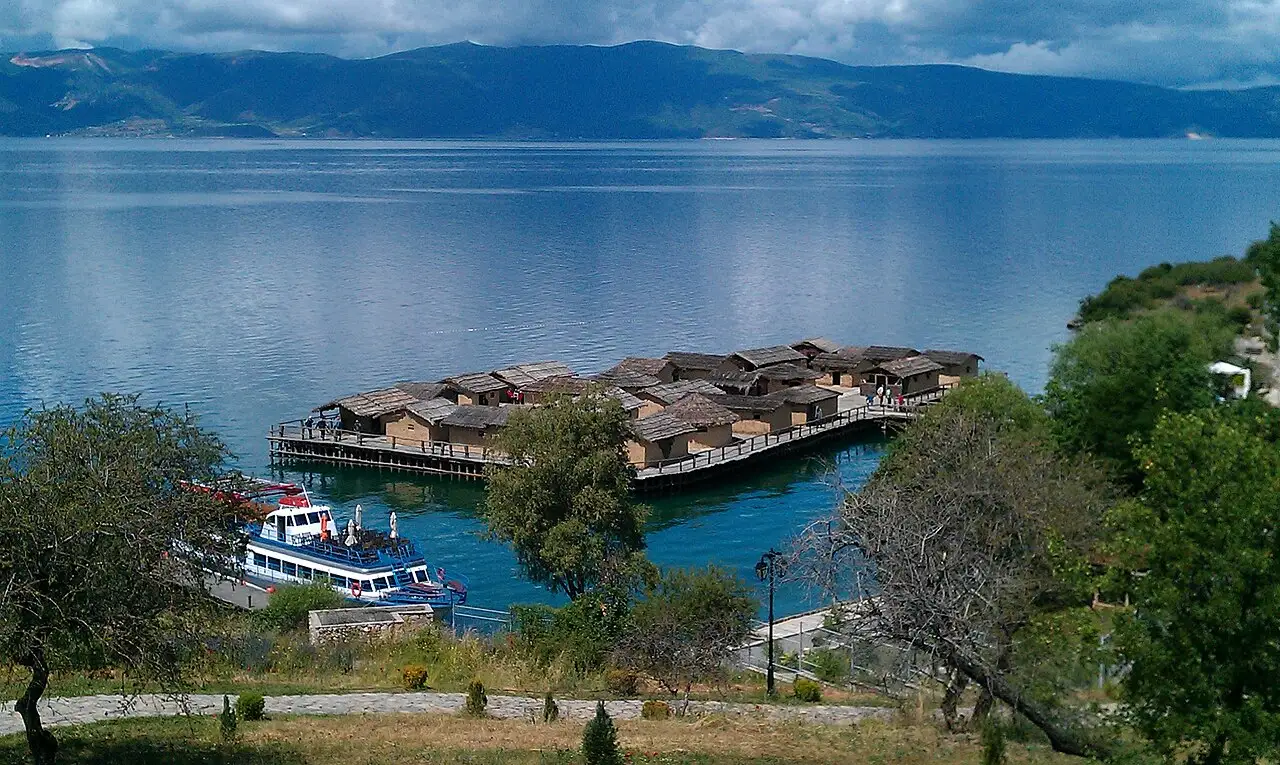
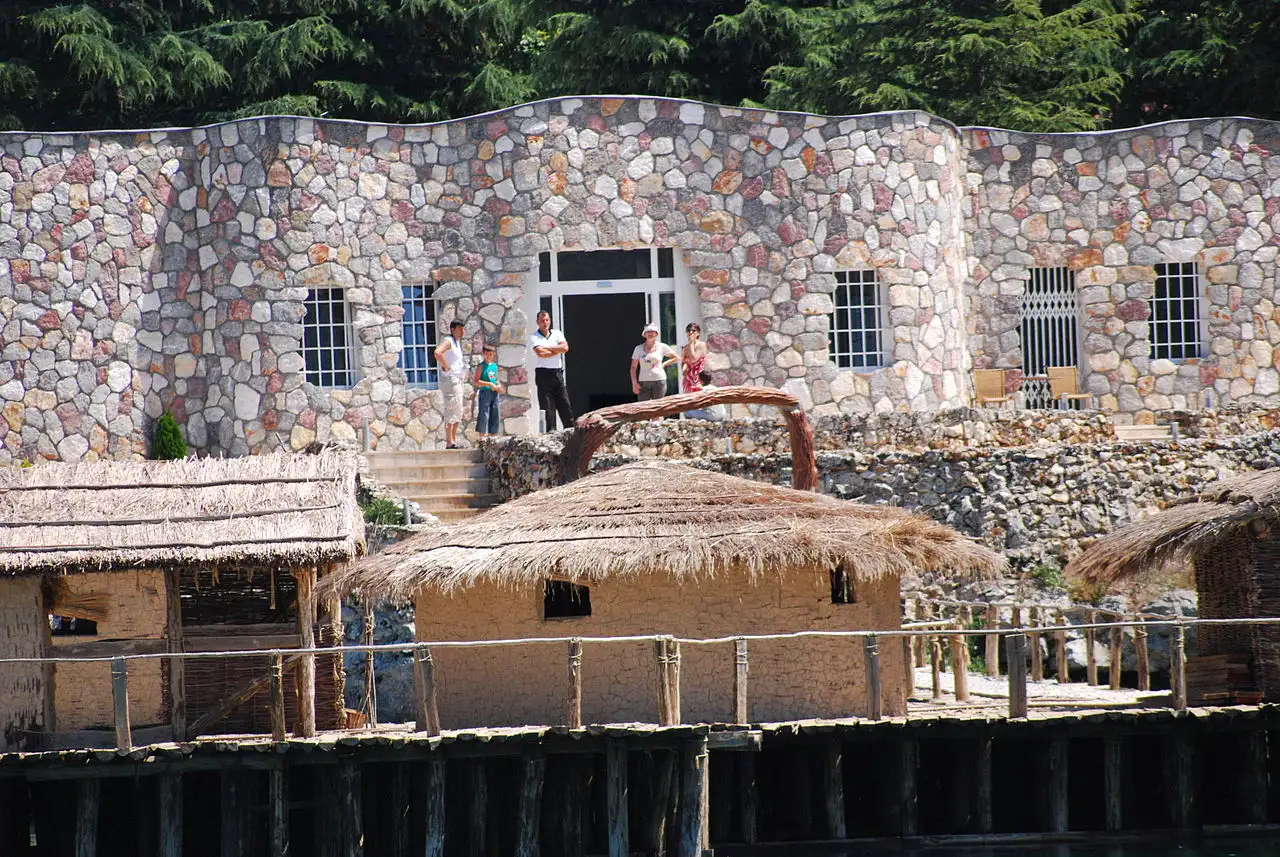
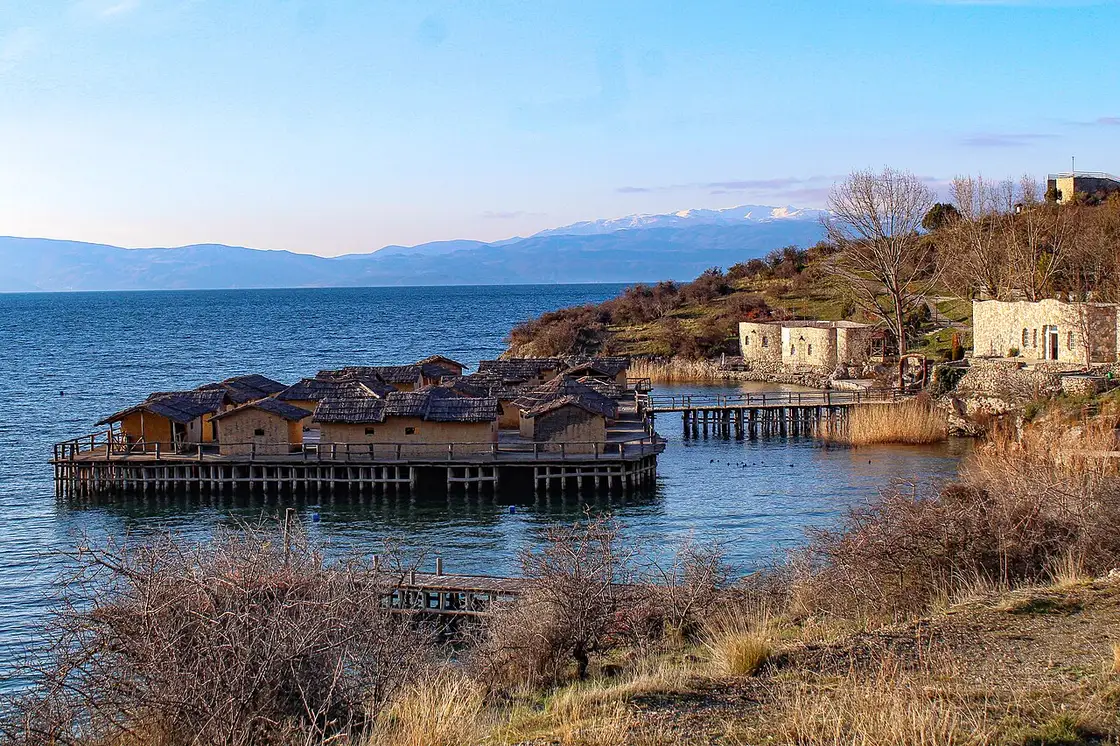
The Bay of Bones is a reconstructed prehistoric village on stilts, built out over Lake Ohrid about 16 km south of Ohrid town - a cluster of reed-roofed huts on a wooden platform standing where a real Bronze Age settlement once stood on the lake bed. Its proper name is the Museum on Water (Muzej na voda), and it’s one of the more unusual stops around the lake: half open-air museum, half archaeological reconstruction, with a dive centre attached. Set expectations first - the huts you walk through are a modern rebuild from 2008, not ancient ruins - and it earns its couple of euros as a genuinely odd, photogenic hour.
What you are actually looking at
The village recreates a pile-dwelling settlement - a palafitte - of the kind that stood in this bay in the Late Bronze and Early Iron Age, roughly 1200 to 700 BC. Prehistoric people built their houses not on the shore but out over the shallows, on a platform raised on wooden piles driven into the lake bed. It kept them clear of raiders and animals, and put them right on top of the fish and fresh water that fed the community. The reconstruction copies that arrangement faithfully: around twenty mud-and-timber huts with reed roofs, linked by a plank boardwalk, standing on their own forest of piles a few metres above the water.
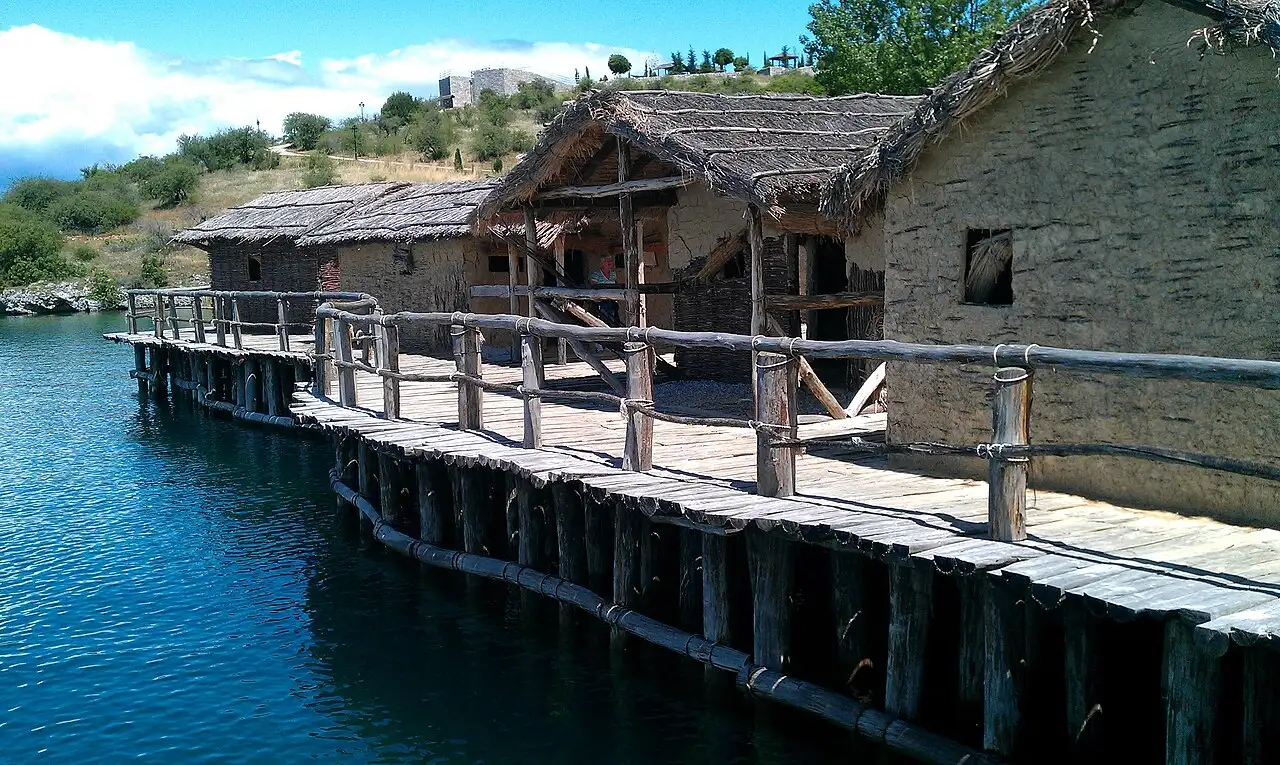
Underwater archaeologists working the bay registered about 6,000 of the original wooden piles still fixed in the lake bed, at a depth of three to five metres, along with the pottery, stone and flint tools, bronze objects and bone implements now shown in the museum. The original settlement covered something like 8,500 square metres. As for the grim name - the Bay of Bones, Zaliv na Koskite - it’s said to come from the sheer quantity of animal bones the divers pulled from the mud among the piles.
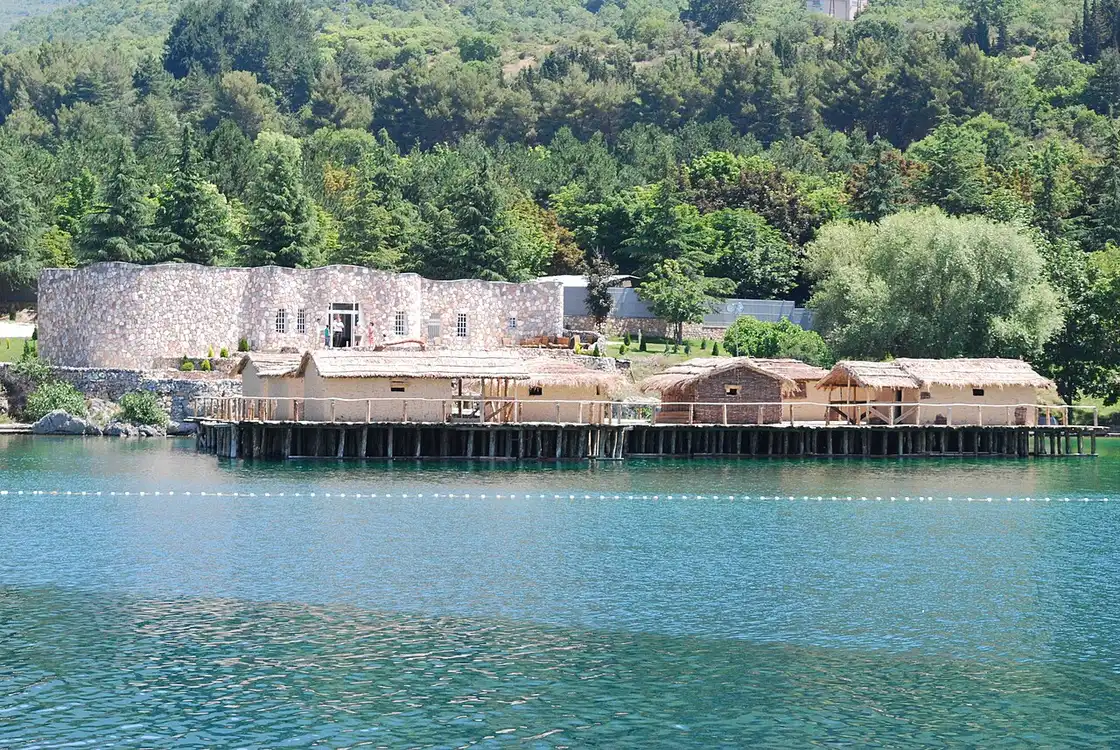
What the reconstruction gets across, better than any diagram, is how self-contained a life this was. The settlers fished the lake - including the ancestors of the prized Ohrid trout that still swims below - and farmed and grazed animals on the shore, carrying it all back out to the safety of the water each evening. Better still, a few of the huts are furnished inside, so you can duck through a low doorway into a reconstructed prehistoric home: a hearth, a raised sleeping platform, hanging nets and clay pots. It’s a rare thing to be able to stand inside a Bronze Age house rather than read a label about one.
The museum and the finds
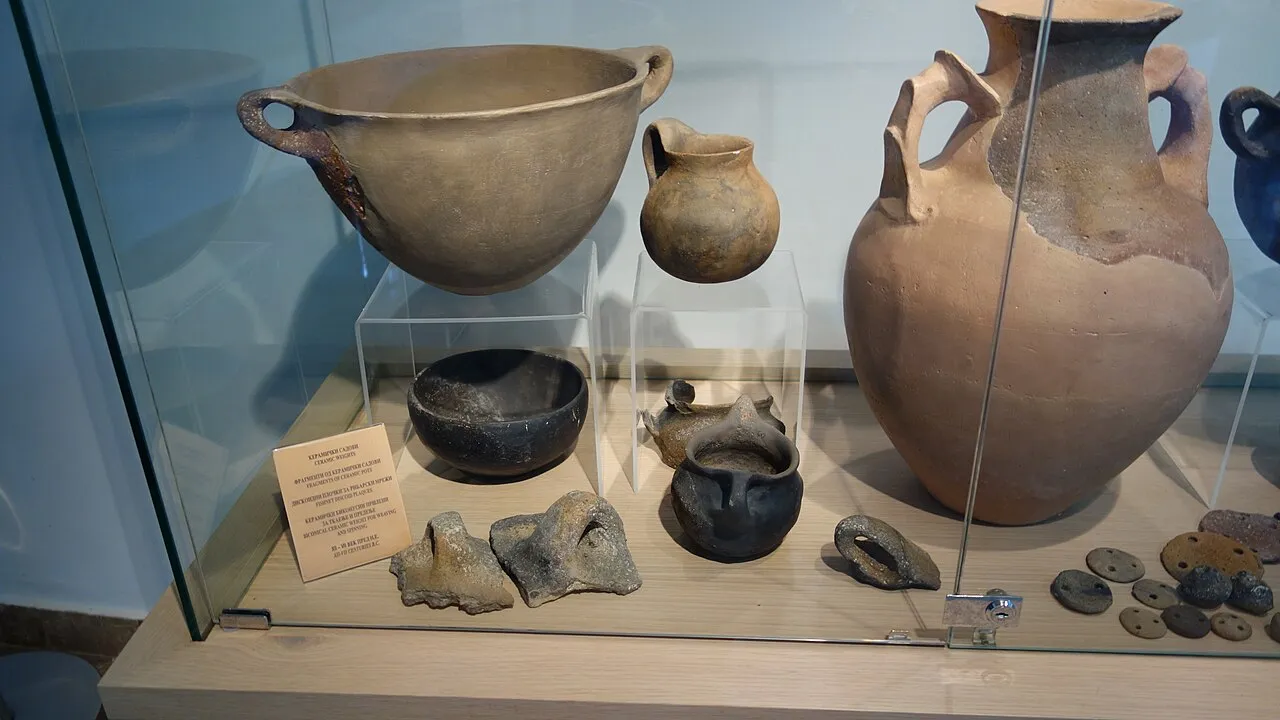
On the shore behind the platform sit the museum’s stone buildings, where the real excavated objects live behind glass: hand-thrown cooking pots and storage jars, clay loom weights, flint blades and small bronze pieces, most dated to that 1200-700 BC window. It is a compact collection, but it’s what turns the huts from a curiosity into something you can connect to the people who lived here three thousand years ago. Together the piles, the finds and the platform make this one of the most important prehistoric sites on the whole lake, and the reason the reconstruction was built right here.
Up on the Gradište hill just behind the bay, the complex also takes in a reconstructed Roman-era hill fort (a castrum), with stretches of wall and towers - a reminder that this shore was worth guarding long after the pile-dwellers had gone. It’s a short climb from the platform and rounds out the visit.
Can you dive it? Yes
Here’s the part most people miss: you can dive the site. A small diving and underwater-archaeology centre operates from the museum, run by the Amfora company, and because the original settlement lies just offshore in shallow water - the bottom here’s only about twelve metres down - it makes an easy, beginner-friendly dive. A guided dip takes you over the submerged piles and finds in situ, and a day runs around forty euros. Even if you never planned to get wet, it is worth knowing this is one of the few spots on Lake Ohrid set up for it, and it’s a far better way to grasp what the settlement was than another lap of the boardwalk.
Tickets, hours and how to get there
Getting in costs a small fee, lately around 100 to 150 denars - roughly two euros, cash only, with a reduced rate for students and children. The museum is open daily except Monday; in season it runs from about 9:00 to late afternoon, with longer hours in July and August and an earlier close in winter. Times drift with the season and aren’t rigidly posted, so if the museum is the whole point of the trip, confirm on the day.
The Bay of Bones sits about 16 km south of Ohrid near the village of Peštani, on the R-1301 road that hugs the eastern shore toward Sveti Naum and the Albanian border. By car it’s a 25 to 30 minute drive, with a free car park on the cliff above. The same road carries the buses that run down to Sveti Naum, so you can get off here for about a euro, though the timetable is loose. A taxi is around fifteen euros one way, or a little more to pair it with Sveti Naum. Easiest of all, the excursion boats that cruise from Ohrid harbour to St Naum usually pull in here, but how long they stay depends on the boat: Ohrid Lake Cruises lists a one-hour stop on its shared tour, while Armada’s page names the stop without saying how long it lasts, so ask before you book if the museum matters to you.
Is it worth it?
It depends on what you want from it. If you’ve come to Ohrid for beaches and boat trips and have half a day spare, the Bay of Bones is a genuinely different stop - a well-made reconstruction of something most of Europe knows only from museum diagrams, in a lovely setting, with the option to swim or dive off it. If you’re a purist expecting original ruins, the modern huts will feel like a film set and the entrance fee like a stretch. The sweet spot is to treat it as one stop on a southern-shore day: combine it with the monastery at Sveti Naum, the long beach at Ljubaništa or the fishing village of Trpejca, and let the boat or the road string them together.
Practical tips
- Bring cash. The ticket is cash-only and small; there is no card machine on a wooden platform over a lake.
- Combine it. Do not drive down for this alone - pair it with Sveti Naum and a swim, or catch it on the boat trip. Half a day covers the southern shore.
- Mind the boardwalk. The planks and rails are rustic and can be slippery when wet; keep an eye on small children near the open edges.
- Ask about diving if the idea appeals - it’s shallow, beginner-friendly and one of the few organised dive spots on the lake.
- Don’t rely on a boat stop. A short cruise stop leaves you rushed, and not every operator says how long its boat stays; come by car or bus if you want time for the museum and the fort.
Read also
- Things to do in Ohrid - the Bay of Bones in the wider Ohrid picture
- Ohrid boat trip to Sveti Naum - the cruise that stops here
- Sveti Naum monastery - the set-piece at the southern tip, best paired with this
- Lake Ohrid guide - the UNESCO lake it stands in
- Best beaches on Lake Ohrid - Ljubaništa and the southern-shore swims nearby
- Day trips from Ohrid - building the southern-shore day
On the map
The map loads on click - to keep the page lightweight.
The map didn’t load. Check your connection and refresh the page.
Admission and opening hours
- Admission price
- Around 100-150 MKD (about EUR 2), cash only; reduced for students and children
- Opening hours
- Open daily except Monday; roughly 9:00 to late afternoon in season, later in July-August, shorter in winter
Hours and prices are seasonal and change - confirm on the day. Closed Mondays.
Details checked: July 20, 2026
Distance
- Skopje ≈185 km · ~3 h Via Ohrid town; no direct bus from Skopje airport.
- Ohrid ≈16 km · ~25-30 min On the R-1301 lakeside road toward Sveti Naum; buses to Sveti Naum pass by.
- Bitola ≈85 km · ~1.5 h
Read also

What to see · 11 min read
Skopje Brutalist Architecture Walking Guide
Verified · September 3, 2026Walk Skopje's post-1963 concrete: Post Office, GTC, Tange's station and MoCA. Dates and architects from named sources.

What to see · 9 min read
Plaošnik & St Clement's: Ohrid's Sacred Hill
Updated · August 25, 2026Plaošnik in Ohrid: St Clement's church, early Christian mosaics and Slavic literacy's cradle - what to see, the walk up and looping Kaneo.

What to see · 9 min read
Skopje Museums: Archaeology to Mother Teresa
Updated · August 23, 2026Four Skopje museums worth an afternoon: archaeology, Mother Teresa, the Holocaust center and Macedonian Struggle - hours, tickets and how to visit.

What to see · 12 min read
Bigorski Monastery: The Carved Wonder of Western Macedonia
Updated · August 4, 2026Sveti Jovan Bigorski: the walnut iconostasis with 500+ carved figures, what the 2009 fire took, and how to get there from Skopje or Ohrid.