
Galichnik Wedding Festival: A Visitor's Guide 2026
A guide to the Galichnik Wedding Festival: when it runs, the two-day rituals, the Teshkoto dance, and how to reach the mountain village.
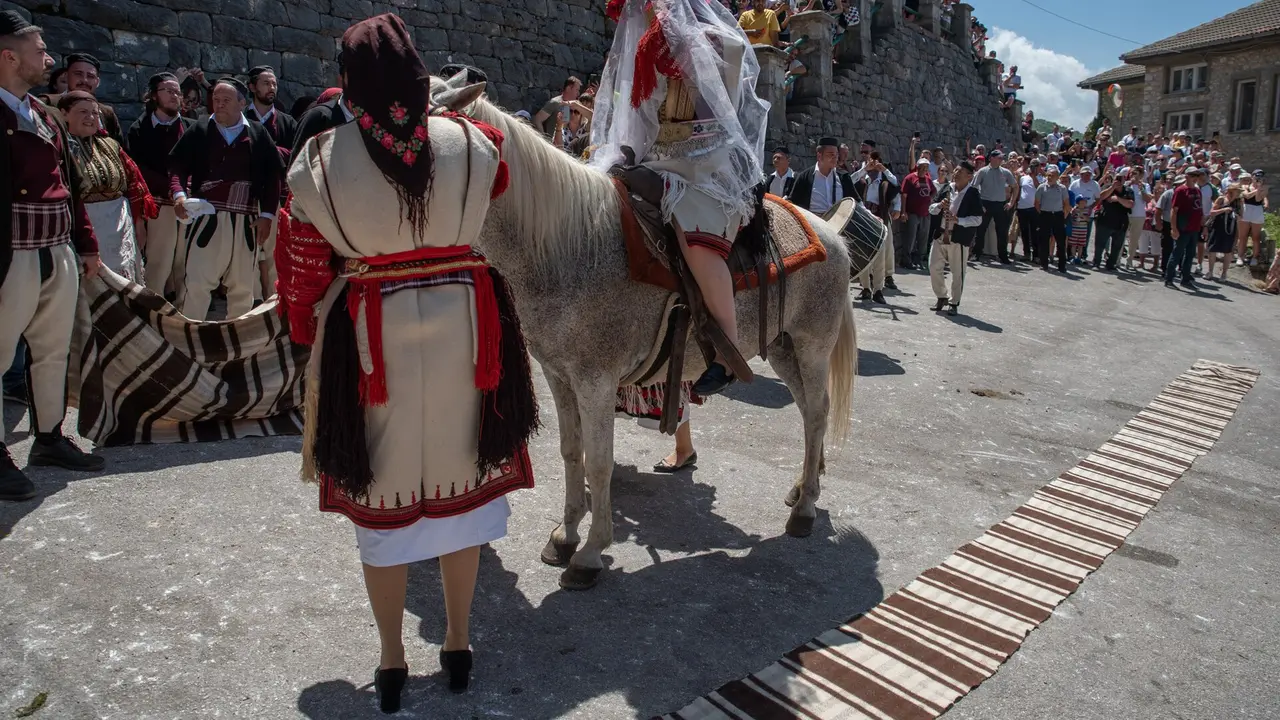
The Galichnik Wedding (Galichka Svadba) is North Macedonia’s most famous folk event: a real couple married in full traditional dress, on horseback, to drums and the thunderous Teshkoto dance, in a near-empty stone village high in Mavrovo National Park. It runs every year on the weekend nearest 12 July (Petrovden, St Peter’s Day), which in 2026 fell on 11-12 July. Watching costs nothing; the hard part is getting there and finding a bed nearby.
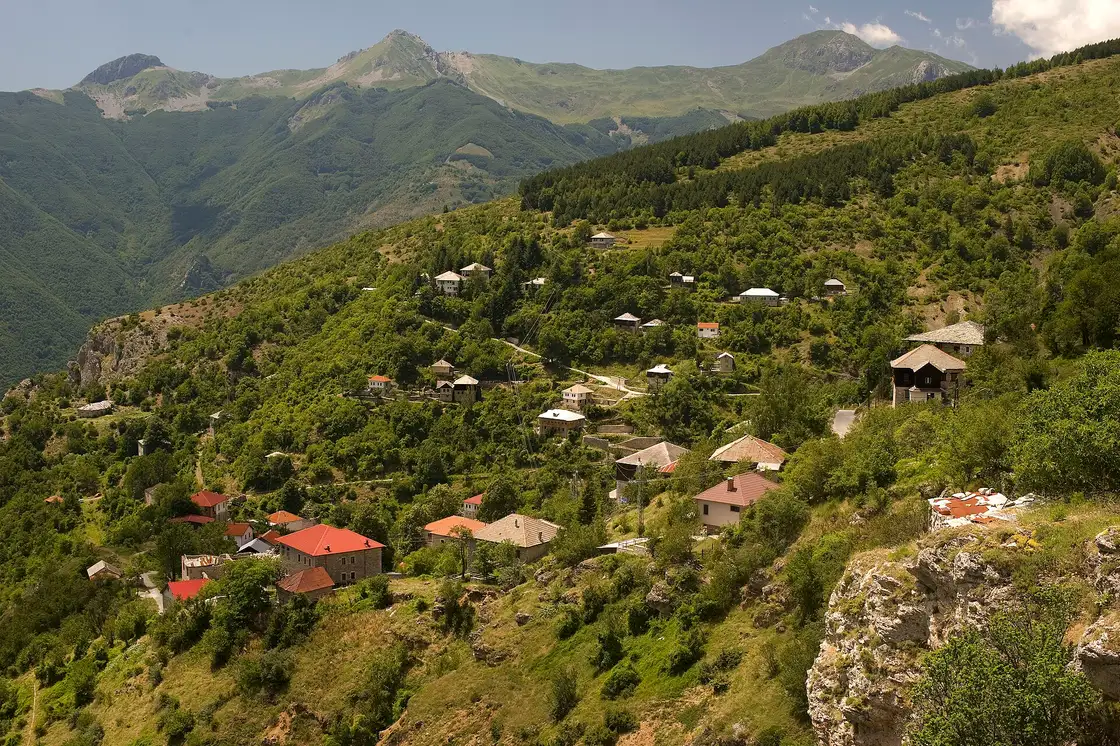
For fifty-one weeks of the year, Galichnik is almost silent. The village sits at about 1,400 metres on the flank of Mount Bistra, and its stone houses stand mostly shuttered, their owners long gone to cities and countries where the work was. Then one weekend in July the road fills, the shutters open, and a few thousand people climb the mountain for a wedding that most of them have no personal stake in at all. That contrast, a ghost village roaring back to life for two days, is the real reason to come.
A wedding built on emptiness
To understand the festival you have to understand why the village emptied. Around 1905 Galichnik had close to 5,000 residents, a wealthy mountain settlement of stonemasons, woodcarvers and dairymen. But the land was hard, winters were long, and the men left in waves as pechalba workers, seasonal migrants who went abroad or to the cities for months at a time. They kept one appointment at home: St Peter’s Day, 12 July, when the emigrants came back and the year’s weddings were held all at once, in folk costume, before everyone scattered again. The first asphalt road didn’t reach the village until 1973, by which point most families had already gone for good.
The festival you see today was created in 1963 to keep that memory alive. For its first decades the “bride” and “groom” were performers acting out the customs. Since 1991 the weddings have been real: each year couples apply for the honour, a local commission chooses one, and at least one of the two must have Galichnik roots. The continuity can be startling. In 2026 the groom, Aleksandar Pendaroski, was the son of the couple who married in that first real wedding of 1991, which tells you how personal this still is for the families whose village it was.
When it happens
The wedding is always tied to Petrovden, the feast of Sts Peter and Paul on 12 July. When the date lands mid-week the festival shifts to the closest weekend; in 2026 the 12th was a Sunday, so events ran across 11-12 July. Some warm-up dances and music can start on the Friday, but the core is the two-day ceremony, with the church wedding falling on Petrovden itself. Watching is free, and there’s no ticket or gate; you simply arrive and join the crowd around the events.
Because the date moves with the calendar each year, check the exact dates before you plan travel rather than trusting an old blog. The organisers and Mavrovo National Park publish the current year’s programme in the weeks before.
The two days, ritual by ritual
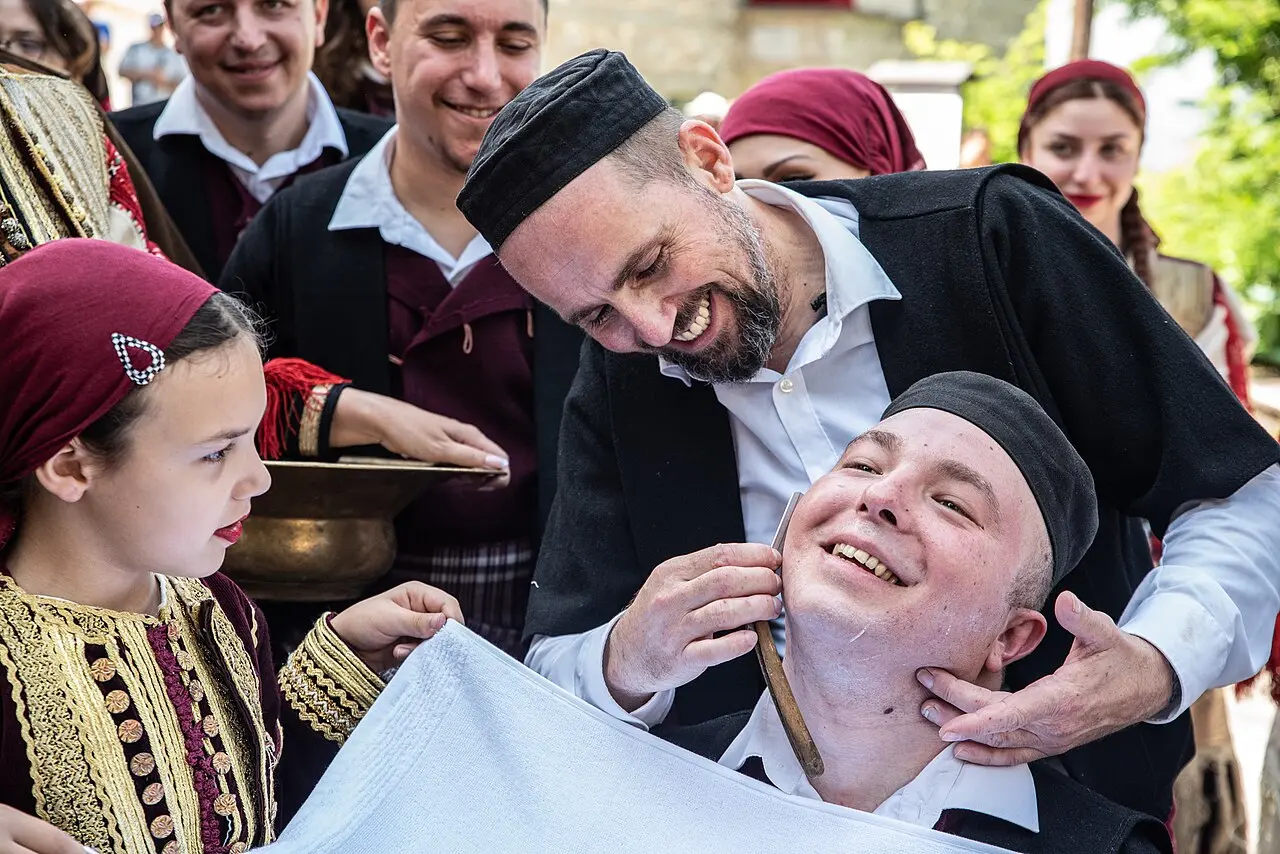
What makes Galichnik different from a folklore show is that the customs run in sequence, roughly the way a real 19th-century wedding would have. The first day belongs to the groom’s side. The village musicians, the majovci, strike up on only two instruments, the zurla (a piercing double-reed horn) and the tapan (a big double-headed drum), and the sound carries clear across the valley. The groom is ritually shaved by his best man in front of a laughing crowd, guns are fired into the air, and the wedding flag, the barjak, is raised and paraded. The groom’s party then walks to ask for the bride, an entourage that can run to fifty in-laws.
The second day, Petrovden, is the wedding proper. The bride, in a costume so heavy it’s a feat to move in, is brought through the village and, in the image everyone remembers, arrives at the church on a white horse led across a woven runner. After the ceremony comes the banquet and the dancing, and the bride leads the nevestinsko oro, the bride’s dance, to close the celebration.
The Teshkoto: the dance that carries the whole story
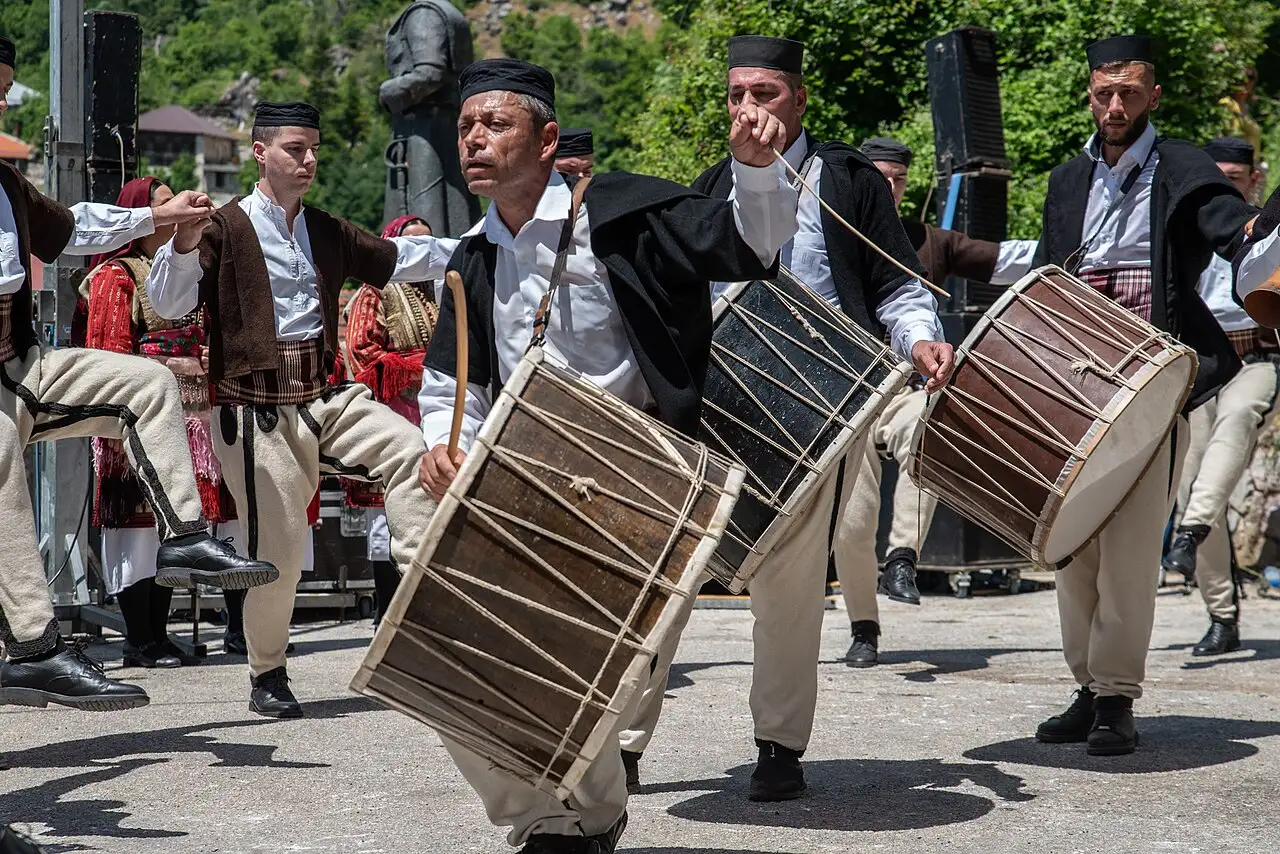
If you catch one thing, make it the Teshkoto (Тешкото, literally “the heavy one”). Danced by men in a slow, weighted line to zurla and tapan, it acts out the emigrants’ departure: the reluctance to leave, the strain, and the long look back at the village. It’s not a crowd-pleaser bolted onto the day but the emotional centre of it, the moment where the wedding and the story of the pechalba come together. Even if you do not know the history walking in, the dance makes it legible; the men move as if the ground itself were pulling against them.
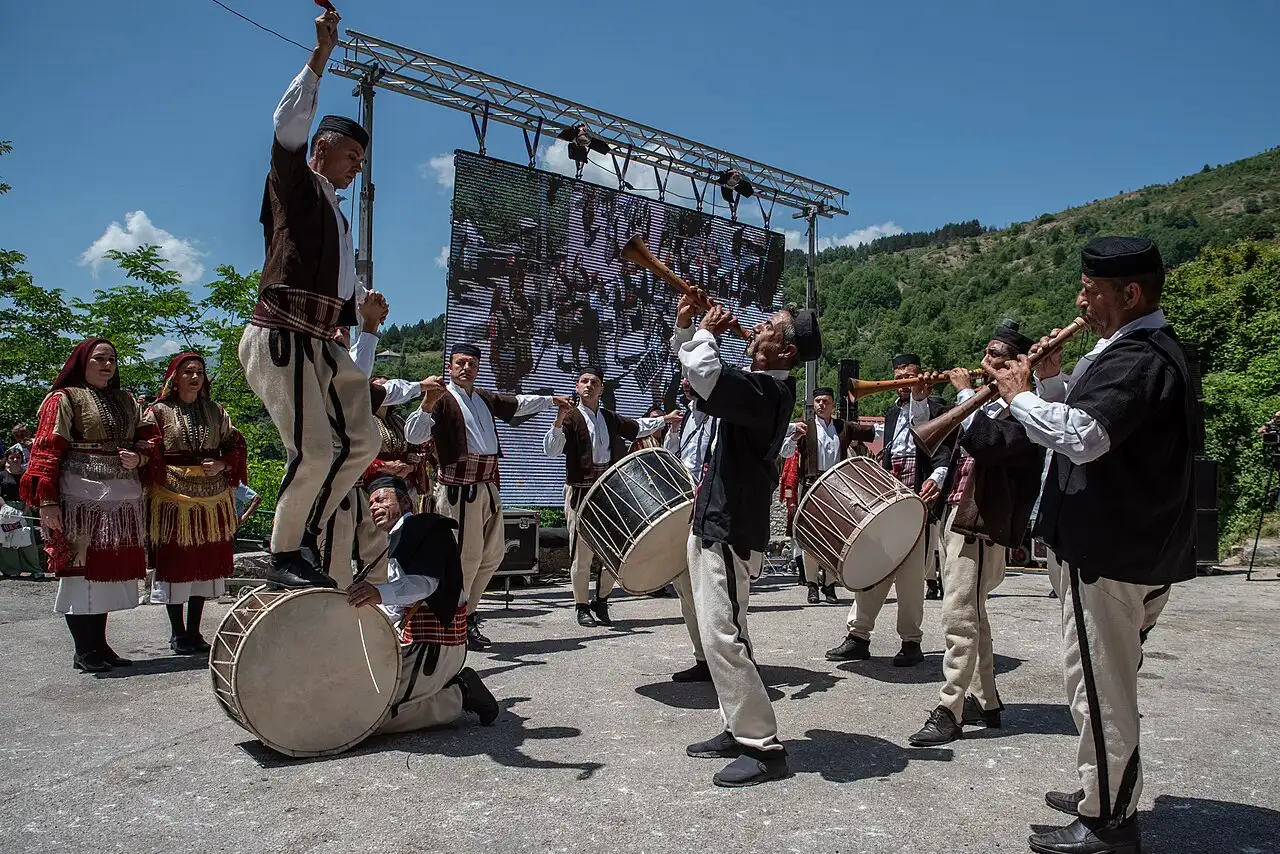
The costumes deserve their own note. The Galichnik and wider Mijak dress is among the most elaborate in the Balkans: wool cloth, dense embroidery, silver clasps and belts hung with old coins. The full bridal outfit is famously heavy, and locals will tell you the layered ceremonial dress can weigh in the region of twenty kilograms, which is part of why the bride moves so deliberately. It is worth getting close enough to see the detail rather than photographing it all from the back of the crowd.
How to get there and where to base
This is the catch. Galichnik has almost no accommodation of its own, and the last stretch is a narrow, winding mountain spur off the main Mavrovo road. From Skopje it’s roughly a two to two-and-a-half hour drive west, out past Gostivar and up into the park. The realistic bases are the Mavrovo resort villages, the town of Debar, or the capital itself for a long day trip. On the festival weekend the small car park fills early, so set off first thing; latecomers park well down the hill and walk up. If you would rather not drive the mountain road yourself, a guided day trip or a hired car with a local driver takes the stress out of it, and our notes on driving in North Macedonia cover the road conditions if you do go under your own steam.
Come dressed for a full day outdoors at altitude. Bring sun protection, sturdy shoes for rough ground, water, and some cash, because card payment is unreliable up here. And keep in mind what you’re actually watching: this is a real couple’s wedding, not a staged reenactment, so the same courtesy you would show at any wedding applies to where you stand and what you photograph.
Make a trip of it
Few people come all this way for a single event, and you shouldn’t either. The wedding sits inside Mavrovo National Park, so pair it with a day in the mountains using our Mavrovo National Park guide, which covers the lake, the hikes and the drive over to the park’s other corners. If you’re basing in the capital and treating this as a big day out, the best day trips from Skopje roundup puts it alongside the other escapes within a couple of hours, and the best time to visit North Macedonia guide helps you slot the rest of your July around it. For how this weekend lines up against Ohrid’s festival, the carnivals and the country’s public holidays, see our North Macedonia events calendar.
Read also
- Mavrovo National Park - the park the village sits in, and how to spend the rest of the day
- Best day trips from Skopje - where Galichnik fits among the capital’s easy escapes
- Best time to visit North Macedonia - planning your July around the festival
- Driving in North Macedonia - roads, mountain sections and what to check
Photos
On the map
The map loads on click - to keep the page lightweight.
The map didn’t load. Check your connection and refresh the page.
Read also

Entertainment · 11 min read
Skopje Jazz Festival: A Visitor's Guide
Updated · September 13, 2026Skopje Jazz Festival, founded in 1982: how the four October nights at the National Opera and Ballet work, what tickets cost, and where to stay nearby.

Entertainment · 10 min read
Tikves Grozdober: Kavadarci's Grape Harvest Party
Verified · September 5, 2026Tikveski Grozdober in Kavadarci: early-September grape harvest festival, carnival, wine stalls, concerts - how to plan a weekend.

Entertainment · 9 min read
Manaki Brothers Film Festival: A Visitor's Guide
Updated · August 26, 2026Manaki Brothers in Bitola: world's oldest cinematographers' festival, 47th edition 19-25 Sep 2026, venues, tickets and where to stay.

Entertainment · 8 min read
Struga Poetry Evenings: A Visitor's Guide
Updated · August 13, 2026SPE 2026 ran 24-29 June in Struga: Golden Wreath, Bridge of Poetry nights, hotels by the lake, and how to plan around the festival.