
Bigorski Monastery: The Carved Wonder of Western Macedonia
Sveti Jovan Bigorski: the walnut iconostasis with 500+ carved figures, what the 2009 fire took, and how to get there from Skopje or Ohrid.
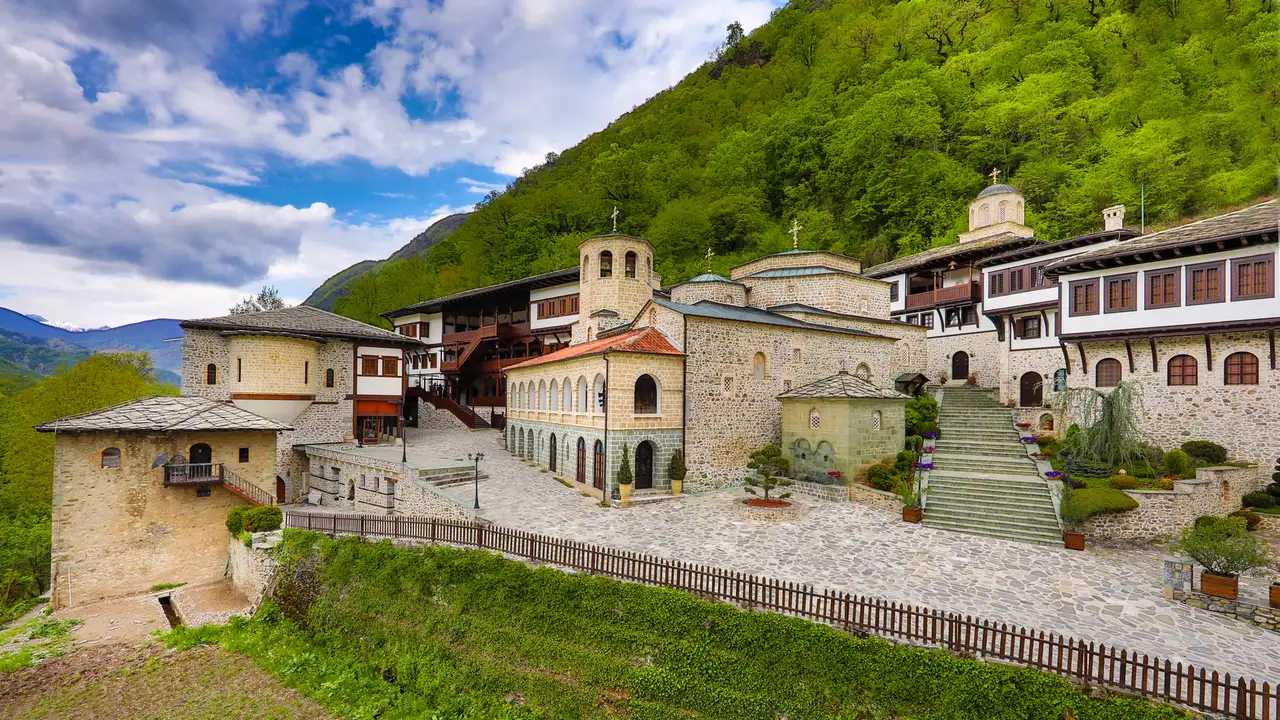
Bigorski Monastery stands on a ledge above the Radika gorge in western North Macedonia, 115 km from Skopje and 90 km from Ohrid, and the reason people drive out here’s a wall of carved walnut. The iconostasis in its church was cut between 1829 and 1835 and carries more than 500 human figures and around 200 animals. The monastery publishes no admission price and no bus stops at the gate, so the trip costs you a morning and, realistically, a car.
That carving survived by luck. Around four in the morning on 30 September 2009, fire caught in the kitchen and went through the Upper Palace, the residential range holding the monks’ quarters and the library. The monastery’s own account of what was left is blunt: every room and all the furniture inside burned, and the only things still standing were the stone walls. The church survived, and the iconostasis with it. The National Conservation Centre later put the damage at over 5.5 million euros. Much of what you walk past on the way in went back up after May 2010, so don’t spend the visit trying to date the stonework in your head.
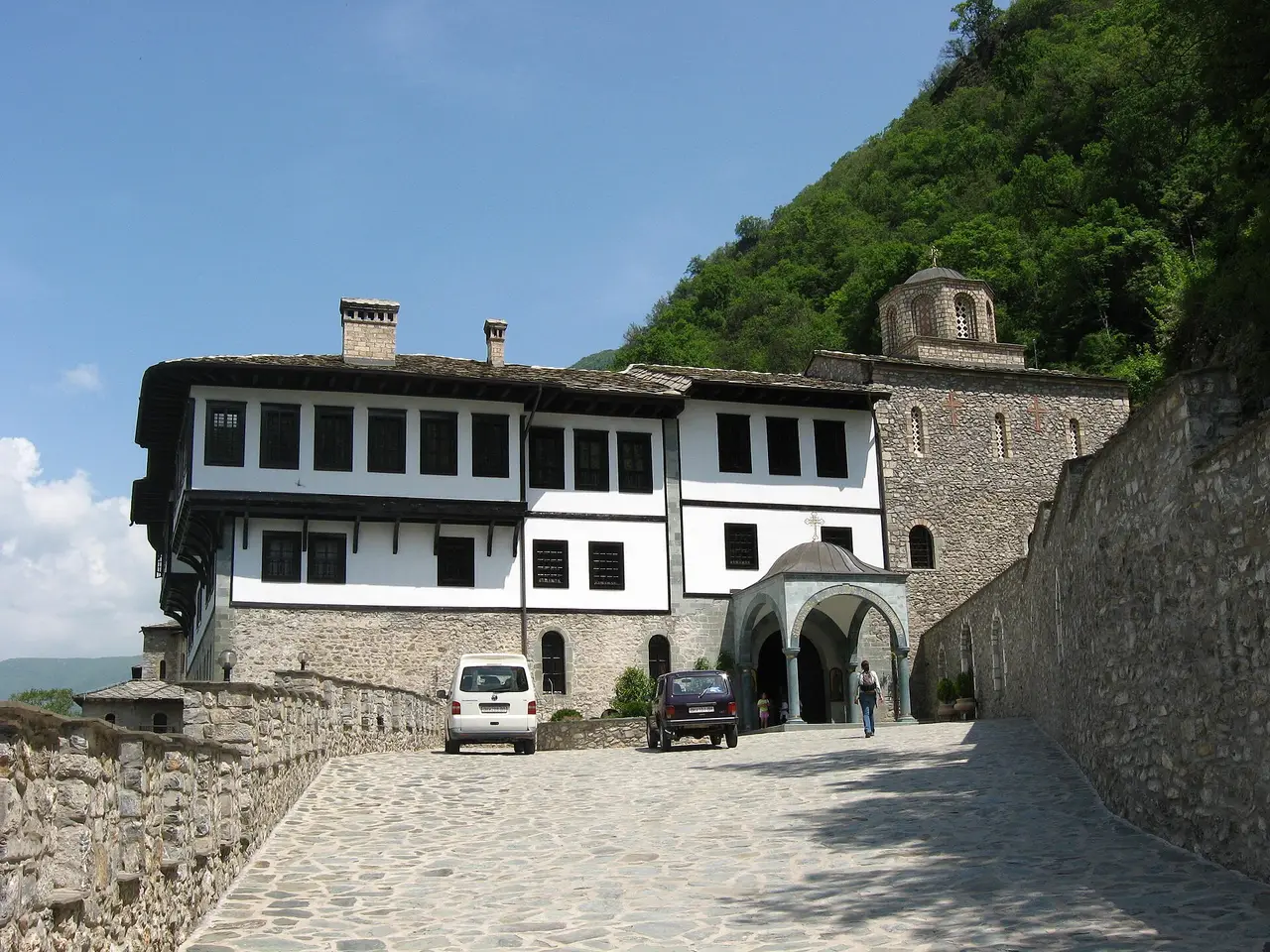
A monastery built out of the rock it is named after
The full name is Sveti Jovan Bigorski, the monastery of St John the Baptist, and the odd second word is the local one for travertine. Researchers at HAEMUS describe the complex as built from rock hewn out of the travertine cliffs of Mount Bistra, so the walls around you came out of the slope they stand on.
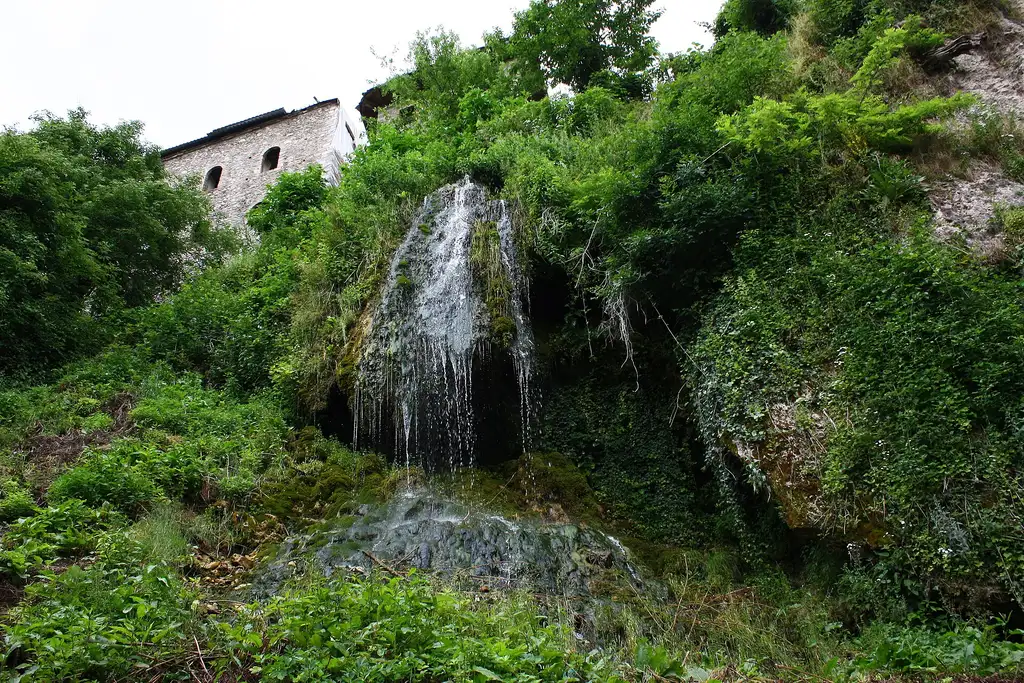
Below the walls there’s a spring that spills over a mossy, mineral-crusted shelf, which is how bigor gets made in the first place: spring water, limestone, time. It’s the sort of thing most visitors walk straight past on their way up to the church.
The monastery’s own chronicle, written in 1833, puts the foundation at 1020 and credits John of Debar. It was wrecked in the 16th century under Sultan Selim II, and the revival came much later: the monk Ilarion arrived in 1743 and started rebuilding, and Archimandrite Arsenius pushed the complex outward from 1814 with dormitories and refectories. The church you enter went up at the end of the 18th century in the Mijak style of the surrounding villages, with an Ottoman ferman granting permission, and its interior decoration began in 1810.
So the honest summary of the age question: a thousand-year-old foundation, a church of about 1800, a refectory block and ossuary of the 1820s, and residential ranges around them that were rebuilt or built outright between 2006 and the years after the fire.
The iconostasis: 500 figures in walnut
The iconostasis is a three-tier screen of walnut that fills the front of the church, and a team of carvers from the Mijak villages spent years on it. Petre Filipovski-Garkata from the village of Gari led the work with his brother Marko Filipov, alongside Makarij Frčkovski from Galičnik and Avram Dičov with his sons Vasil and Filip. Wikipedia dates the job 1829 to 1835 and the monastery says 1830 to 1835, so call it five or six years of chisel work on one screen, depending on which dating you take.
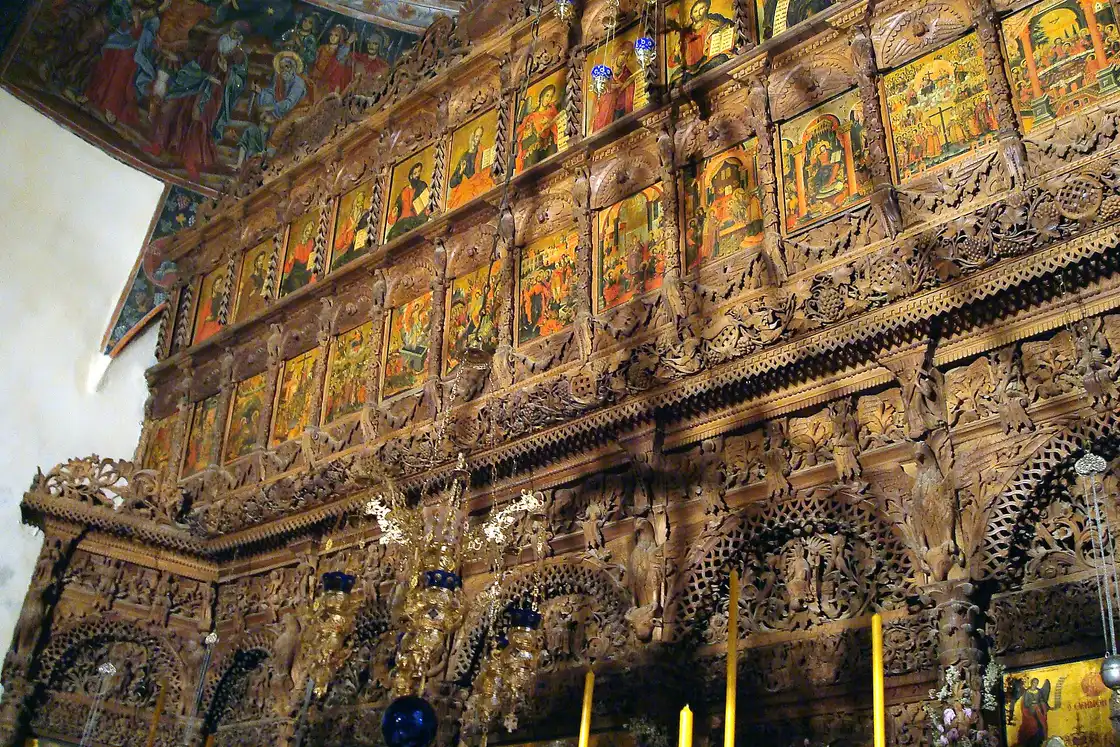
What lifts it above other good Balkan screens is the density. Old and New Testament scenes run through it, and the carvers packed every gap between them with vine and leaves, birds and animals, until there’s barely a patch of plain wood left on the whole screen. That’s where the counts come from: more than 500 human figures and around 200 animals, all on one wall. Stand close for a couple of minutes and it stops being a wall and turns into something you read.
Then there’s the thing to look for. The carvers put their own portraits into the work, faces among the figures, which is about as close to a signature as a craftsman got in the 1830s. Nobody at the door will point them out, and the light inside is low, so give your eyes a minute to adjust and work along the lower panels.
The icons set into all that woodwork were painted at the same time by Michael of Samarina and his son Demetrius, who later became the monk Daniel. In the refectory the wall painting of the 1830s, continued by Dičo Krstevič of Tresonče, is described by HAEMUS as a unique surviving painted ensemble in the Balkans from that period. Whether you get to see the refectory depends on the day and on who’s showing you round, so ask.
One comparison worth making before you commit a day to the drive. The same workshop, a decade earlier, cut the walnut iconostasis of Sveti Spas in Skopje, which stands in the middle of the Old Bazaar and costs you a ten-minute walk instead of a mountain road. Skopje’s is superb and far easier to reach. Bigorski’s is bigger and still in the setting it was made for, and that setting is half of what you’re coming for.
The reliquary, the icon and the silver babies
The church holds a reliquary of 1833, commissioned by Abbot Arsenius, brought from Constantinople and paid for by a merchant named Hadži Nake from the village of Beličica. Inside are relics of St John the Baptist along with St Marina, St Paraskeva, St Pantaleon, St Charalambos and others, plus a particle of the Holy Cross. The monastery doesn’t specify which relic of the Baptist it keeps, and neither will we.
The object people actually queue at is the icon of St John the Baptist. The monastery’s telling is that the founder found it floating in the air above a spring. What makes it stick isn’t the legend, though, it’s the hardware: the icon is hung with small silver medallions shaped like babies, left by couples who came here to ask for a child and came back to say thank you. Read that however you like. As a piece of human evidence in a display case, it’s hard to walk past.
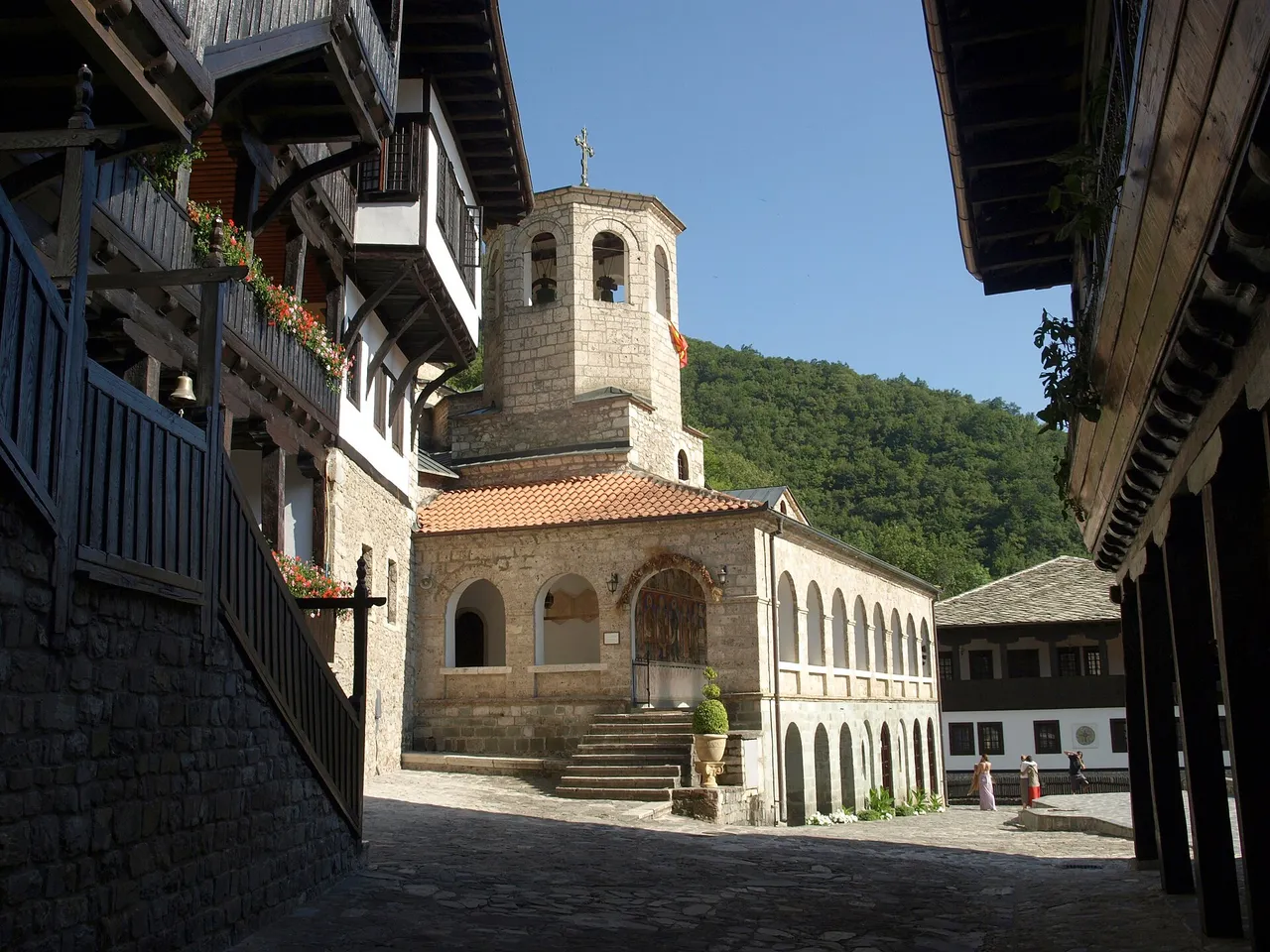
The rest of the complex is worth a slow loop: the ossuary of 1827, the arcaded fountain built in 2008, and the eastern range finished between 2007 and 2010 with a library of more than 30,000 books and an eight-bell clock tower. If the courtyard fills up with a tour group, the arcaded gallery on the valley side is where to go and wait them out.
How to get to Bigorski Monastery
The monastery sits above the main Debar to Gostivar road, inside Mavrovo National Park. Driving times below are measured to the monastery itself and checked on 4 August 2026.
| From | Distance | Time by car |
|---|---|---|
| Skopje | 115 km | ~2 h 15 min, via Tetovo and Gostivar |
| Ohrid | 90 km | ~1 h 30 min, via Struga and Debar |
| Debar | 21 km | ~30 min |
| Mavrovo | 26-35 km | 40-50 min, depending which part |
| Bitola | 123 km | ~2 h 20 min |
By car is the honest answer. The road up from the junction is a short, steep set of switchbacks with parking at the top, and having your own wheels is what lets you add Galičnik or the Duf waterfall to the same day. Our guide to renting a car in North Macedonia covers what to pick up in Skopje and what these mountain roads ask of it.
By bus, it’s a project. Nothing runs to the gate. Buses from Skopje to Debar pass the junction on the main road, so you ask the driver to drop you there and walk up. An aggregator listing for the Skopje to Debar route showed up to seven departures a day, the earliest at 08:30 and the last at 17:00, run by Džeki Turs Ekspres, Hisari GD and Radika prevoz Centar Župa. That’s a schedule site rather than an operator timetable, so confirm the times and the return at Skopje bus station before you commit. From the junction it’s about 800 m of switchback road up to the gate, 10 to 12 minutes on foot at a walking pace, measured on routing.openstreetmap.de on 4 August 2026. It looks like nothing on a map and feels like a climb in August heat.
On a tour is what most people without a car end up doing, usually as a Mavrovo day trip out of Skopje that also takes in Galičnik and the sunken church. It solves the timetable problem and costs you the freedom to linger.
What it costs, what to wear, and staying the night
Nothing is sold at the door. The monastery publishes no price anywhere, and as far as it states there’s no ticket to buy at the gate; a donation, a candle or something from the shop is how visitors contribute. Bring small denar notes rather than counting on a card reader.
There are also no published opening hours, which catches people out. The monastery’s own contact page lists phone numbers and no schedule at all. In practice the gate is open through the daylight hours and the services run early morning and evening, but if you’re driving two hours each way, ring +389 42 333 399 first.
Dress for a working monastery: shoulders and knees covered, long trousers for men, a skirt and a head covering for women. Wraps are usually available at the gate, though that’s traveller practice rather than a promise. Keep your phone silent, and ask before you photograph inside the church.
You can stay overnight, but read the conditions before you get excited. The monastery asks guests to arrange it several days ahead through Fr Anatolij or Fr Cyril (+389 70 223 252) with the abbot’s blessing, and taking part in the services and the common meals isn’t optional. Smoking, alcohol and casual dress are all out. It’s hospitality on the community’s terms, not a room with a view.
One date to plan around or avoid, depending on what you want: the monastery feast, the Beheading of St John the Forerunner on 11 September, is kept with an all-night vigil and draws serious crowds. Come then for the atmosphere, come any other day for the carving.
Where to eat and sleep nearby
At the junction where the access road meets the main road stands Kuḱa na Mijacite, the House of the Miyaks, an ethno-restaurant on the road up that calls itself the first restaurant and museum of Mijak culture. It opens 08:00 to 22:00 Monday to Saturday and from 10:00 on Sunday, and has four rooms upstairs named Bigorski, Krchin, Duf and Radika. The kitchen runs to grilled meat, river trout and the mountain cheeses of Galičnik and Lazaropole.
For a proper base, most people sleep around Mavrovo for the lake and the ski centre, or in Debar, 21 km down the valley and the nearest town of any size. Two kilometres from Debar there’s also the convent of St George the Victorious at Rajčica, a dependency of Bigorski, where the nuns embroider vestments and bishops’ mitres and sell the work on site. The community says its mitres are sought by Orthodox churches well beyond Macedonia, and one of the sisters has named recipients from Greece and Serbia to Russia and America. It makes an obvious pairing with Bigorski if you have the afternoon.
Is Bigorski worth the detour?
If you care about craftsmanship, yes, without hesitation. Very little else in the country repays half an hour of standing still the way that iconostasis does, and the setting above the Radika earns the drive on its own. Add Mavrovo National Park around it and you’ve got a full and genuinely good day.
If you’re on a tight loop with no car and the schedule is fighting you, be realistic. Two hours on a bus, a walk up a switchback road and an opening time nobody publishes is a lot of friction for one building, however extraordinary. In that case take the Mijak carving you can reach easily in Skopje, and save Bigorski for a trip where you’re driving.
The trap to avoid is treating it as a photo stop. Tour groups tend to give it the courtyard and a quick look through the door, which gets you the postcard and misses the reason the place is famous.
Read also
- The park it sits in: Mavrovo National Park
- The drive that strings it together: Skopje, Matka and Mavrovo loop
- The Mijak village up the hill: Galičnik Wedding festival
- Before you book wheels: renting a car in North Macedonia
- Getting west from the capital: how to get to Ohrid from Skopje
Photos
On the map
The map loads on click - to keep the page lightweight.
The map didn’t load. Check your connection and refresh the page.
Admission and opening hours
- Admission price
- No published price, and as far as the monastery states no ticket is sold at the gate. A donation, a candle or something from the monastery shop is the normal contribution. Checked 2026-08-04.
- Opening hours
- The monastery publishes no opening hours. In practice the gate is open through the daylight hours and services run early morning and evening; phone +389 42 333 399 before a long drive.
This is a working male monastery. Shoulders and knees covered, no beachwear, phones silent, and ask before photographing inside the church.
Details checked: August 4, 2026
Distance
- Skopje ≈115 km · ~2 h 15 min by car via Tetovo and Gostivar No direct bus. Skopje to Debar services pass the junction on the main road, then you walk up.
- Ohrid ≈90 km · ~1 h 30 min by car via Struga and Debar The easiest base for a day trip if you are already on Lake Ohrid.
- Bitola ≈123 km · ~2 h 20 min by car
Read also

What to see · 11 min read
Skopje Brutalist Architecture Walking Guide
Verified · September 3, 2026Walk Skopje's post-1963 concrete: Post Office, GTC, Tange's station and MoCA. Dates and architects from named sources.

What to see · 9 min read
Plaošnik & St Clement's: Ohrid's Sacred Hill
Updated · August 25, 2026Plaošnik in Ohrid: St Clement's church, early Christian mosaics and Slavic literacy's cradle - what to see, the walk up and looping Kaneo.

What to see · 9 min read
Skopje Museums: Archaeology to Mother Teresa
Updated · August 23, 2026Four Skopje museums worth an afternoon: archaeology, Mother Teresa, the Holocaust center and Macedonian Struggle - hours, tickets and how to visit.

What to see · 11 min read
Kuklica Stone Town: North Macedonia's Petrified Wedding
Updated · July 23, 2026Kuklica stone dolls near Kratovo: how the pillars formed, the wedding legend, how to get there and the entry-fee dispute you should know about.