
Struga Travel Guide
Struga, North Macedonia: Ohrid's quieter, cheaper lakeside twin where the Black Drin leaves Lake Ohrid - what to see, where to stay, how to get there.
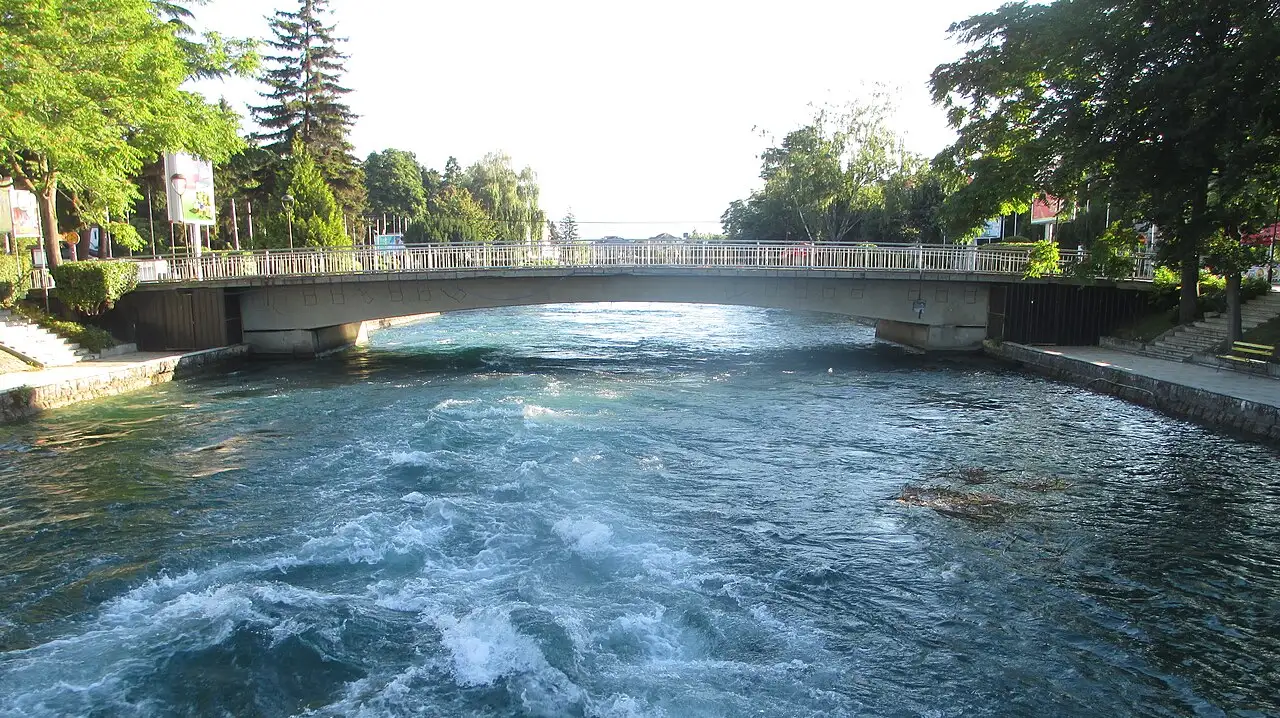
Struga is Lake Ohrid’s other town - quieter, flatter and noticeably cheaper than Ohrid, sitting 15 km up the shore at the exact spot where the lake spills out and becomes the Black Drin river. That river, not the lake, is the town’s spine: it runs green and fast straight through the centre, under a string of bridges, and gives Struga a character all its own. Most people treat it as a budget base for Lake Ohrid, and it works brilliantly for that - same swimming, half the crowds, lower room rates - but it’s also the launch pad for the Vevčani springs, the cliffside Kalište monastery and the Albanian border. This guide covers what there is to see, when to come, where to sleep and how to get here.
Is Struga worth visiting, or should you just stay in Ohrid?
Both, ideally. Ohrid has the UNESCO old town, the churches and the big-hitting sights; Struga has the lake without the price tag and a slower, more local feel. Struga is cheaper overall, but dinner with a view is an Ohrid evening - our Ohrid restaurant guide maps the terraces and old-town kitchens. If your trip is about museums and Byzantine frescoes, base yourself in Ohrid. If it’s about swimming, cheap seafood dinners by the water and using the lake as a place to unwind, Struga is the smarter - and lighter-on-the-wallet - choice. They’re only about 15 km and a 20-minute minibus apart, so plenty of travellers stay in one and day-trip to the other.
What Struga is not is a resort. The centre is an ordinary Macedonian lake town: a working place with a big Albanian community, a scruffy-but-lively market street and a riverfront that comes alive on summer evenings. That ordinariness is part of the appeal - you feel like you’re somewhere people actually live, not just a postcard.
What to see in Struga
The town is flat and compact, so everything below is an easy walk. Give yourself a lazy half-day and you’ll cover it.
The Black Drin and the bridges
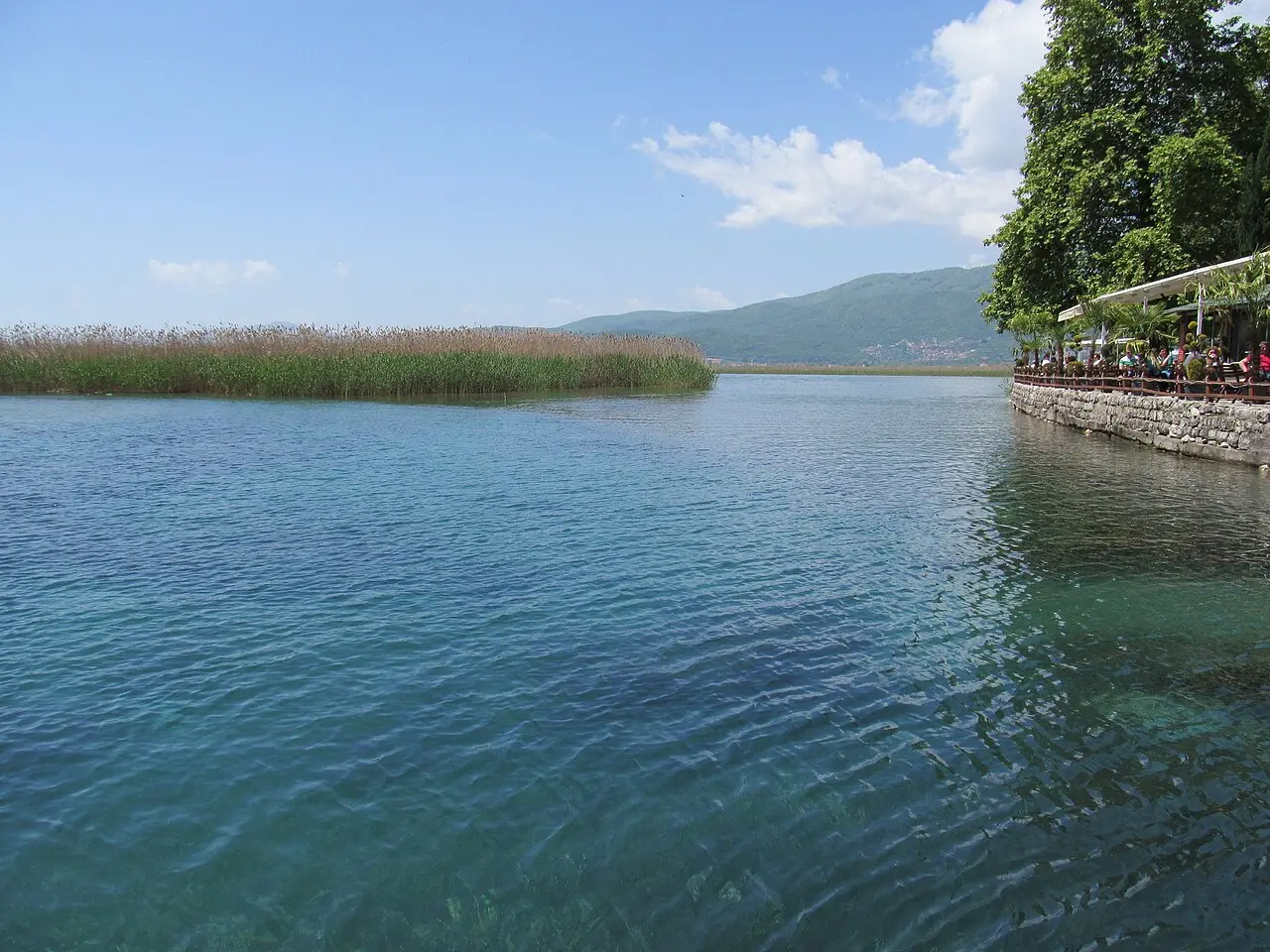
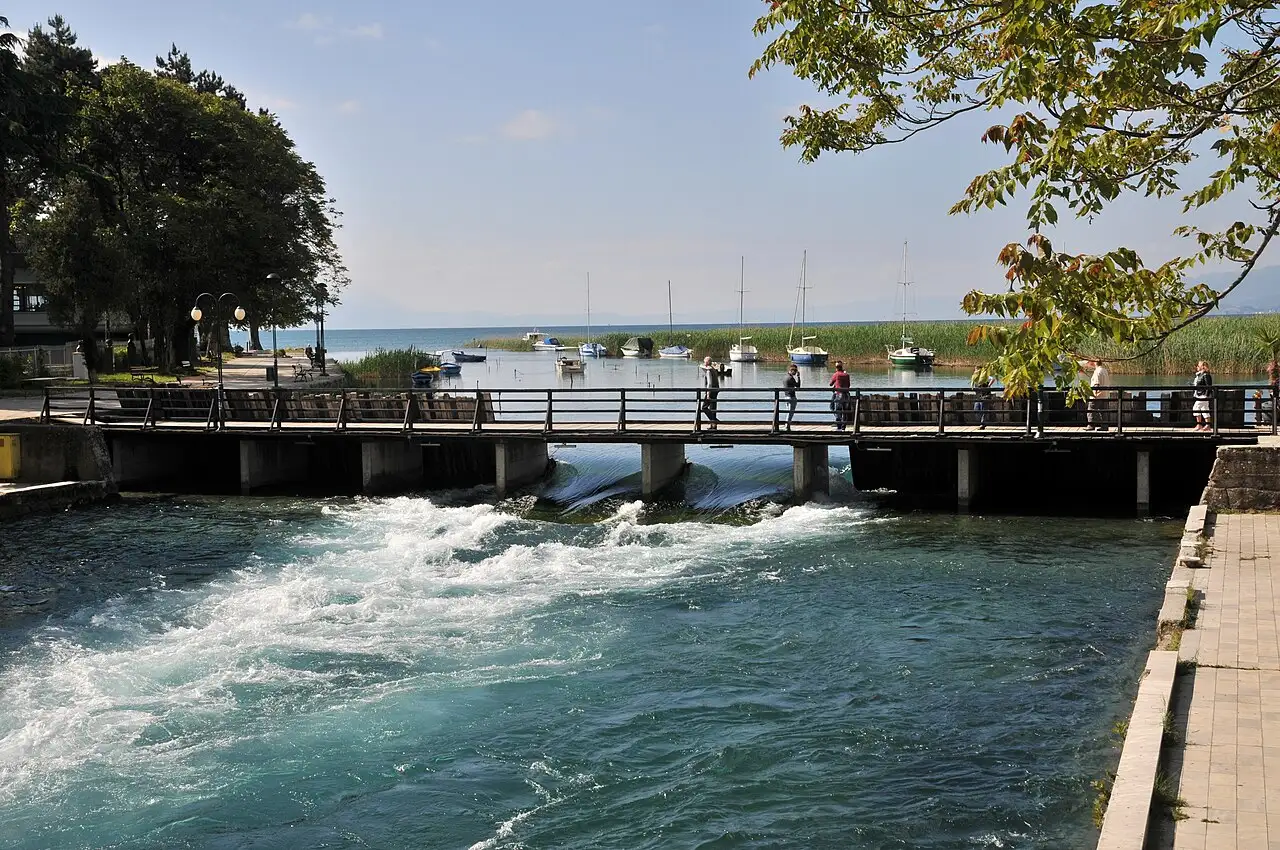
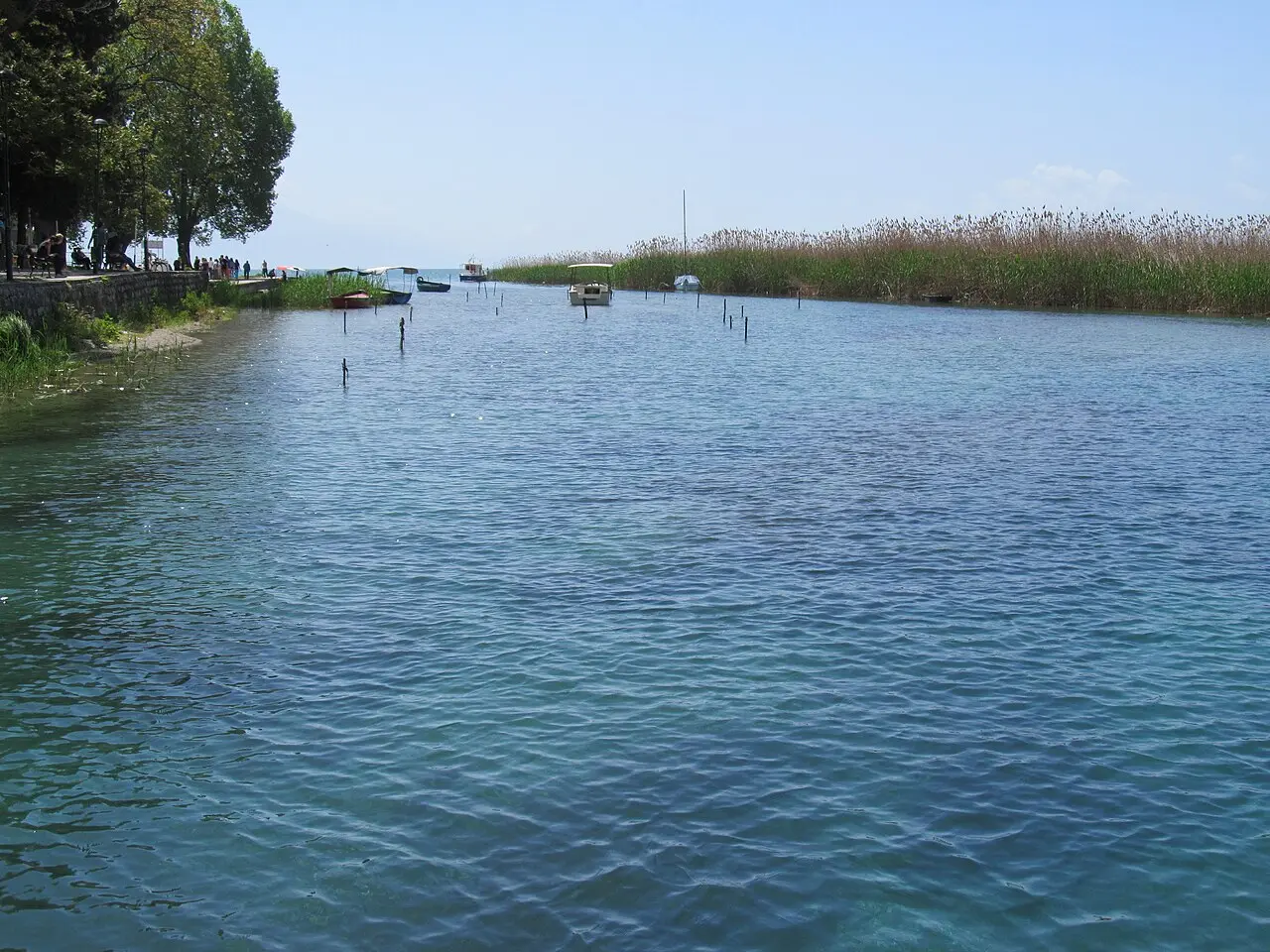
Start at the river. The Black Drin (Crn Drim) is the only outflow of Lake Ohrid - all that water, filtered clear by the lake’s springs, leaves here and rushes north toward Albania and eventually the Adriatic. In the middle of Struga it’s a genuinely beautiful sight: a wide, fast, blue-green channel running between stone embankments and tree-lined promenades, crossed by several bridges. Lean over the railings and you can watch shoals of fish holding in the current. The river-mouth, where the Drin meets the open lake, is the town’s classic photo spot, especially at dusk.
The Bridge of Poetry
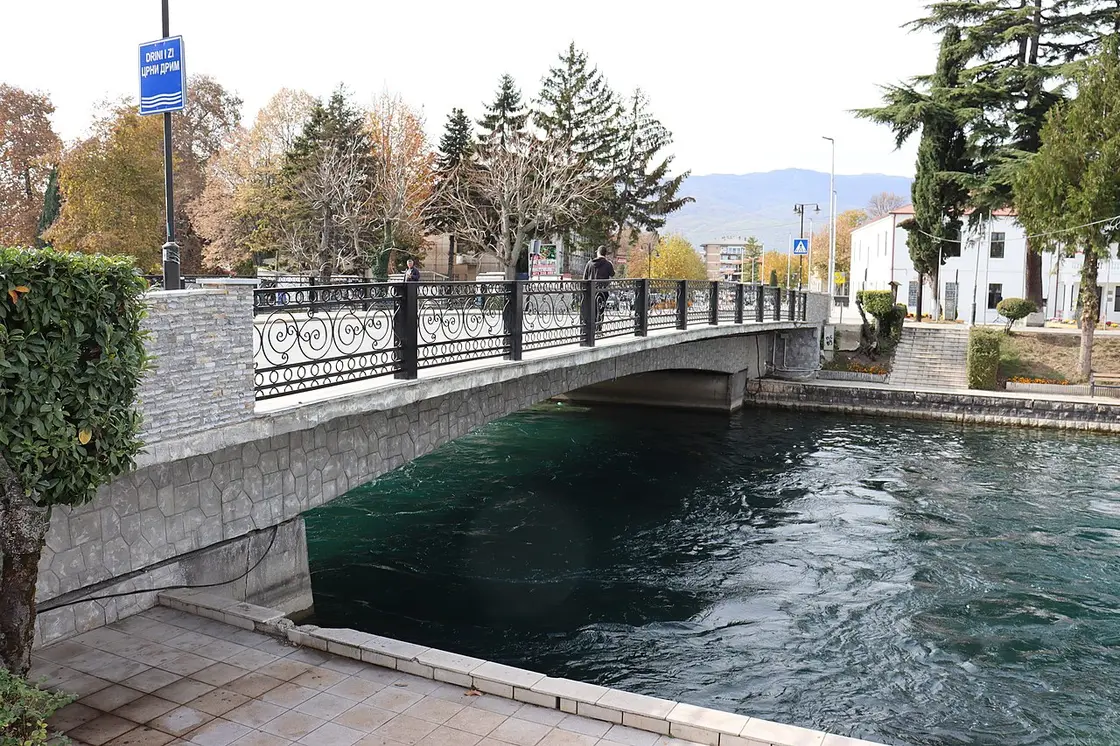
One of those bridges is the reason Struga has a name far bigger than its size. The central pedestrian crossing is the Bridge of Poetry, tied to the Struga Poetry Evenings - one of the oldest and most prestigious poetry festivals in the world. It began in 1961 as a night of readings for Macedonian poets, went international in 1966, and has since drawn a roll-call that reads like a literature syllabus: W.H. Auden, Pablo Neruda, Allen Ginsberg, Joseph Brodsky, Seamus Heaney, Mahmoud Darwish, Margaret Atwood. Each year one poet receives the festival’s Golden Wreath, and the closing reading is held out on this bridge over the river.
If you want to catch it, note that the timing has changed. The 65th festival ran 24-29 June 2026, moved forward from its traditional late-August dates to sit ahead of the peak-summer crush - so the late-August week that guidebooks still flag is now an ordinary one here. The organisers haven’t called the move permanent, and these dates shift from year to year, so check the official programme at svp.org.mk before planning around it rather than trusting a fixed month. For dates, awards, bridge-night logistics and where to sleep that week, see our Struga Poetry Evenings visitor guide. Our North Macedonia events calendar tracks this move alongside the country’s other shifting festival and holiday dates.
The old bazaar and the centre
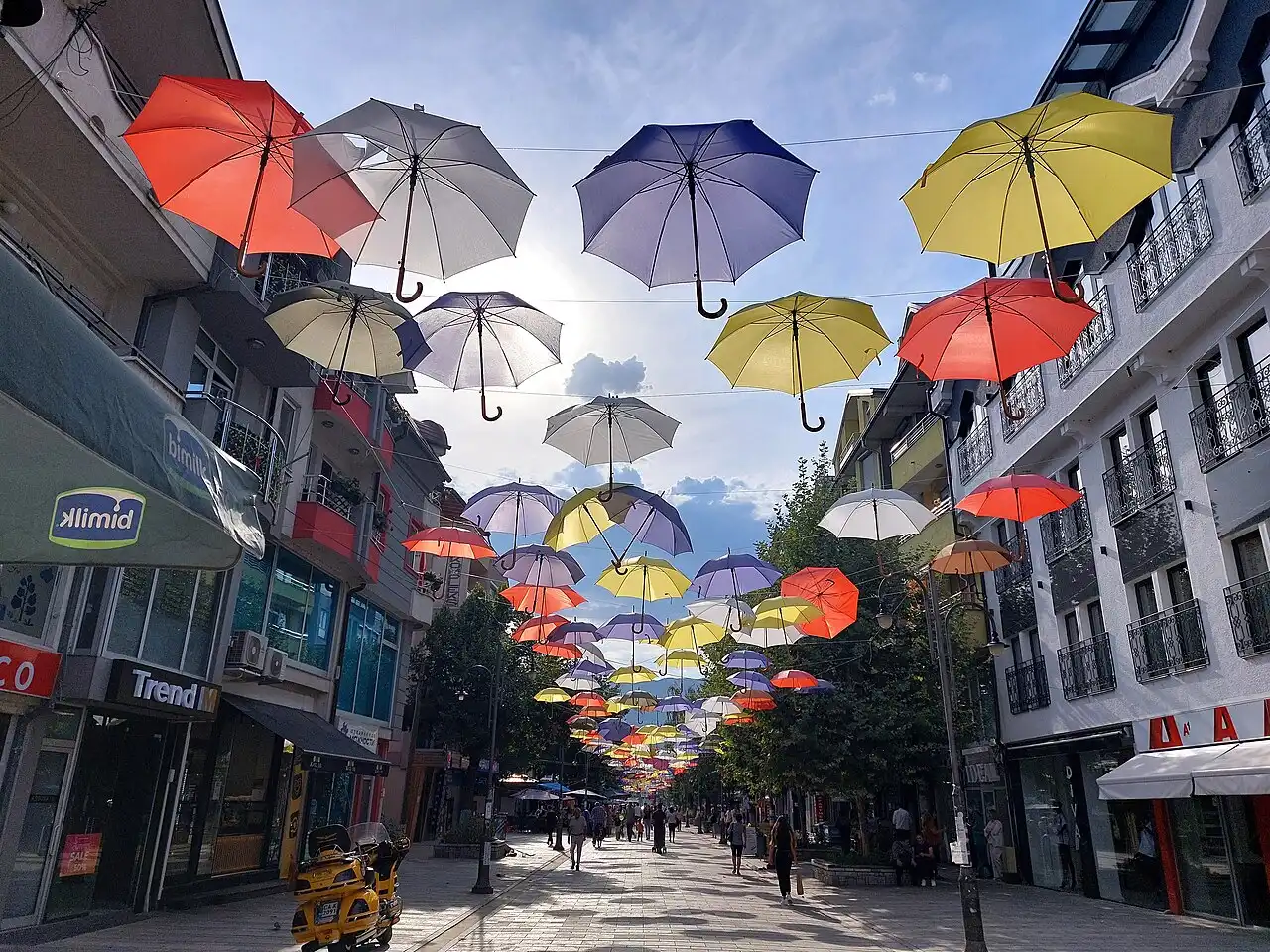
Struga’s main drag is the old market street, the historic bazaar that these days is a pedestrianised run of cafés, bakeries and small shops - and, in summer, a canopy of brightly coloured umbrellas strung overhead. It’s a good place to feel the town’s mix: Struga has a large ethnic-Albanian population, and the mosques, the language on the shopfronts and the food all give it a different flavour from Macedonian-Orthodox Ohrid. Duck off the main street and you’ll still find pockets of old Struga - weathered 19th-century houses with timber upper floors leaning over cobbled lanes.
The beaches
The real draw in summer is the water. Struga’s lakefront has a string of pebble and mixed beaches right in and beside town, plus the promenade for evening strolls. The lake here is the same startling clarity as at Ohrid, and because Struga sees fewer package tourists, the beaches are calmer and cheaper - you’ll pay less for a sunbed and a lot less for lunch. The water is cold-ish even in high summer (it’s a deep mountain lake), but perfectly swimmable from roughly June to September.
Ohrid pearls
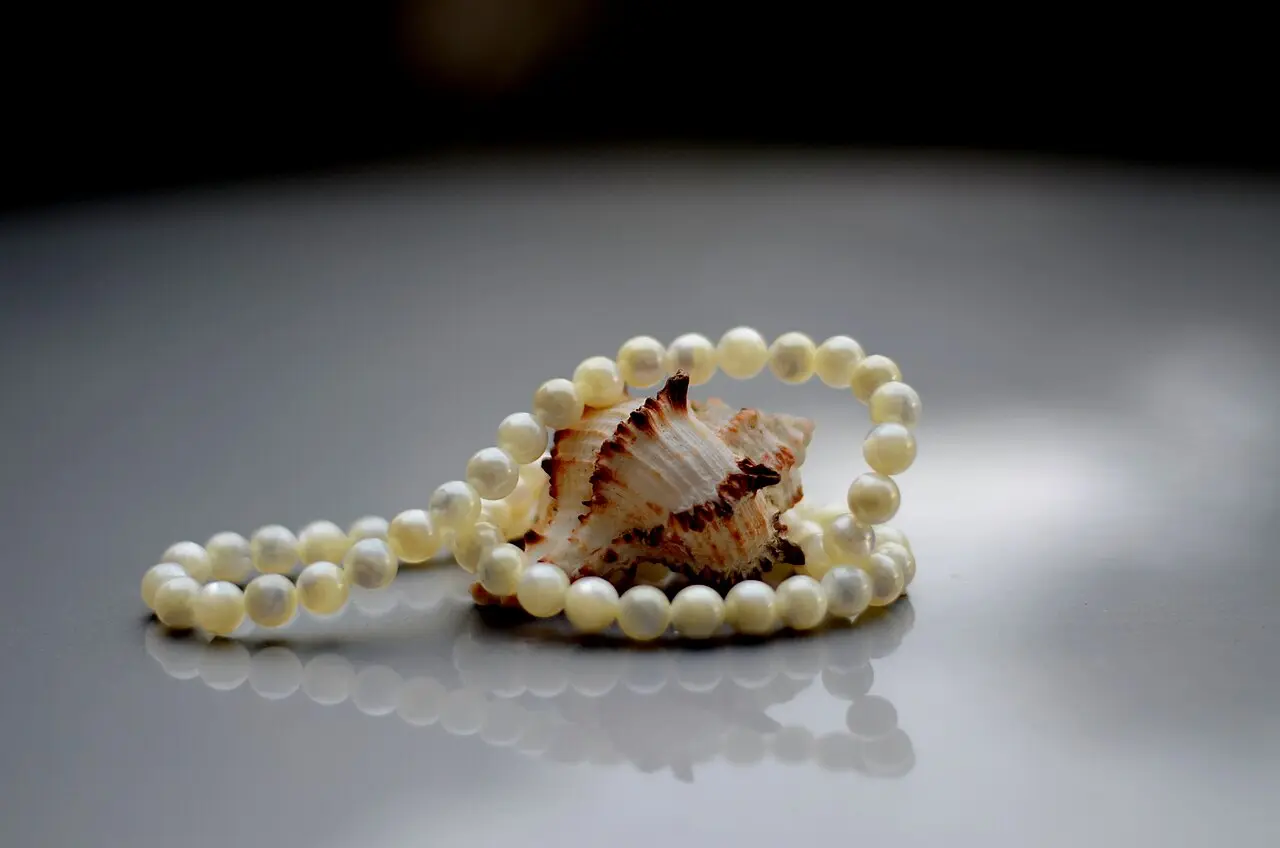
If you see shops selling “Ohrid pearls”, this is the region that makes them - and they’re not what you’d guess. These aren’t oyster pearls at all: they’re beads coated with an emulsion made from the silvery scales of the plašica, a small fish endemic to Lake Ohrid, applied over a mother-of-pearl core. The exact recipe is a closely guarded secret, historically held by just two local families, and said to have arrived with a Russian émigré around a century ago. Genuine pieces are hand-made and priced accordingly; cheap “pearls” on market stalls are imitations. Worth knowing the difference before you buy one as a souvenir.
Day trips from Struga
Struga’s other job is as a base. Three trips are within easy reach.
Kalište Monastery
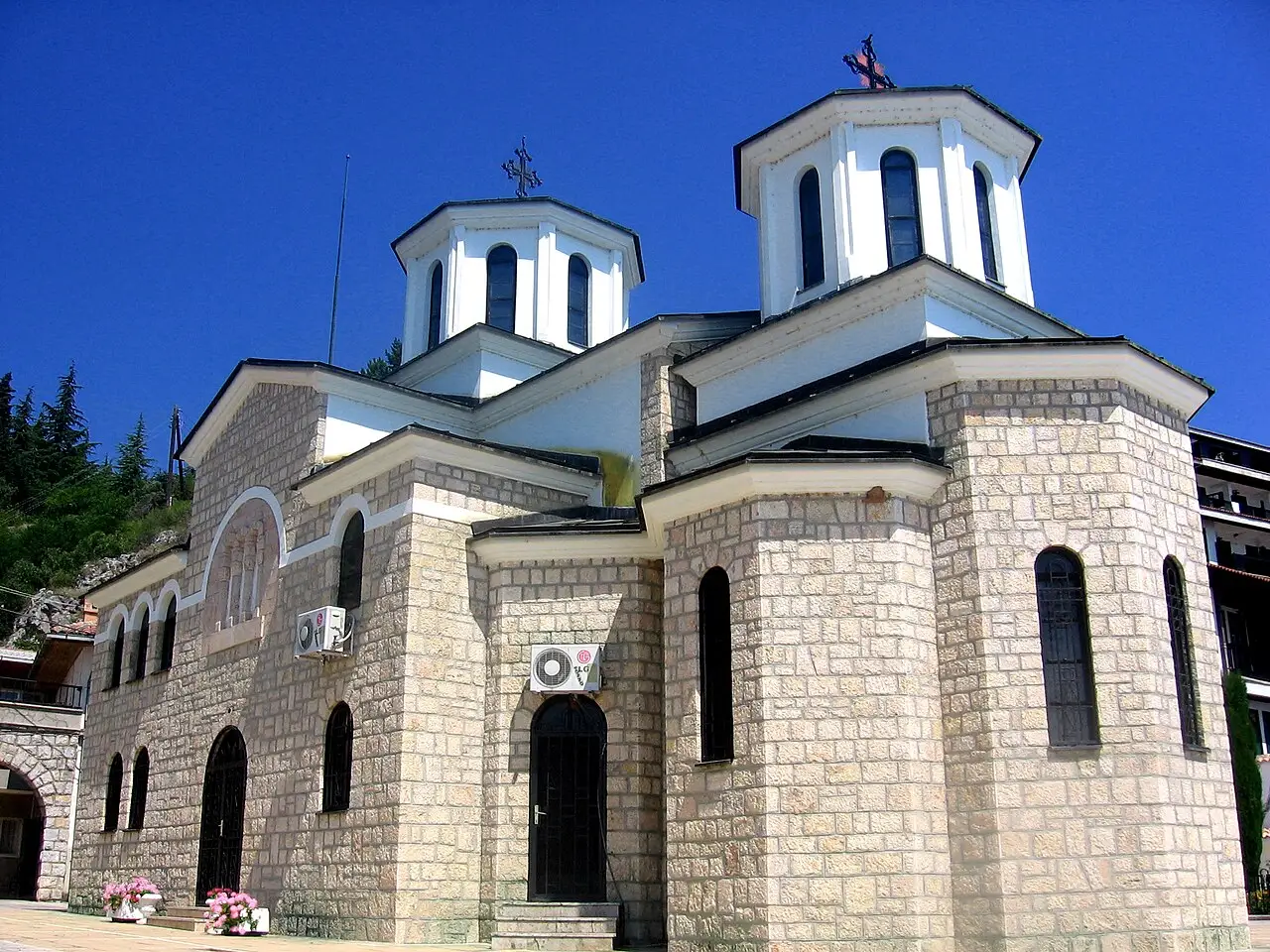
About 4-5 km south of Struga, tucked against the cliffs where the shore road runs toward the village of Radožda, is Kalište (Kalishta) Monastery - a lakeside complex built around cave churches cut into the rock, the oldest dedicated to the Nativity of the Mother of God and begun back in the 14th-15th century. You can drive, take a boat across the bay, or (if you’re keen) walk along the shore. It’s a peaceful, atmospheric spot with the lake spread out below.
Vevčani
Up in the hills about 14 km north-west of town, Vevčani is a proudly independent little village famous for two things: its karst springs, which gush out of the mountainside into a series of pools and channels shaded by old trees, and its riotous Vevčani Carnival, held every 13-14 January to mark the old-calendar New Year - a centuries-old masked festival that’s a spectacle in its own right if you’re here in deep winter. The springs make a lovely short outing any time of year.
Across to Albania
Struga sits close to the border, and the Albanian side of Lake Ohrid - the resort town of Pogradec and the beaches around it - is a short hop south-west. Buses run across, making Struga a natural first (or last) stop if you’re linking North Macedonia with Albania around the lake.
Where to stay in Struga
Struga’s headline selling point is price: rooms run noticeably cheaper than in Ohrid for a comparable standard, and its hotels sell by beach rather than by neighbourhood. Our where-to-stay guide for Struga breaks down the price bands, names hotels against the beaches they sit on, and covers the Kalishta-versus-Radozda trade-off. It also works in reverse: some travellers base themselves in the cheaper town and day-trip the 20-30 minutes into Ohrid, which our where to stay around Lake Ohrid guide covers from that side.
When to go and how long you need
Summer (June-September) is the season - that’s when the beaches, the lakefront cafés and the swimming are at their best, and when the town feels alive in the evenings. Late June now also brings the poetry festival. The flip side is that July and August are the busiest and priciest weeks; late spring and early autumn are quieter, cheaper and still warm enough to enjoy the water’s edge, even if the swimming is bracing.
For time: Struga’s own sights are a relaxed half-day. Give it a full day or an overnight if you want to swim, eat a long lakeside dinner and add Kalište or Vevčani. As a base for the wider lake, two or three nights is easy to fill once you factor in Ohrid across the water.
How to get to Struga
From Ohrid. This is the everyday connection: it’s only about 15 km, and minibuses run roughly every 20-40 minutes for around 100 MKD, taking 20-30 minutes; a taxi is cheap too. It’s genuinely easy to base in one town and hop to the other.
From Skopje. Struga is about 180 km from the capital - reckon on 2.5-3 hours by car on the road through Kičevo, or take one of the direct buses (a few euros, similar journey time). Many services to Ohrid continue the extra 15 km to Struga.
Nearest airport. The closest is Ohrid “St Paul the Apostle” (OHD), 10 km northwest of Ohrid on the aerodrome sheet - it sits between Struga and Ohrid, so the transfer is no longer from here than from Ohrid itself. Flights are heavily seasonal; otherwise fly into Skopje International (SKP), the country’s main gateway, and continue overland. Note there is no scheduled shuttle bus at OHD, so plan on a taxi or a hire car.
| Route | Distance | Time |
|---|---|---|
| Ohrid → Struga | ~15 km | ~20-30 min by minibus (~100 MKD) |
| Skopje → Struga | ~180 km | ~2.5-3 h by car or direct bus |
| Struga → Kalište Monastery | ~4-5 km | ~10 min by car / short boat ride |
| Struga → Vevčani | ~14 km | ~20-25 min by car |
Distances and times are approximate - confirm current minibus and bus schedules before you travel. For getting around the region, see our transport guide; to explore the lake and the day trips on your own schedule, a rental car is the most flexible option.
A note on visas and money
Two practical things before you go. The currency is the Macedonian denar (MKD), steady against the euro at roughly 61.5 to €1 - carry cash for the market, small cafés and beach kiosks. On entry, US, UK, EU and Ukrainian citizens travel visa-free for 90 days within any 180; Russian citizens need a visa (since 21 March 2022). Rules change, so always confirm with an official source - there is more in our North Macedonia planning hub.
Read also
- The twin town across the water: things to do in Ohrid
- The lake itself: Lake Ohrid, the UNESCO gem
- Beaches and swimming spots: Lake Ohrid beaches & swimming
- Getting to the lake: how to get to Ohrid from Skopje
- Plan the season: best time to visit North Macedonia
- Browse all cities of North Macedonia
Photos
On the map
The map loads on click - to keep the page lightweight.
The map didn’t load. Check your connection and refresh the page.
Distance
- Skopje ≈180 km · ~2.5-3 h by car or direct bus
- Ohrid ≈15 km · ~20-30 min by minibus or taxi
Read also

Cities · 12 min read
Things to Do in Stip: Bargala Ruins & the Isar
Updated · August 29, 2026Stip travel guide: the Isar hill's UNESCO-listed Chetrse ritual, the Bargala ruins, the Bezisten gallery, pastrmajlija, and how to get there from Skopje.

Cities · 8 min read
Demir Kapija, Stobi and the Tikves Wine Road
Updated · July 15, 2026The Demir Kapija gorge, the Roman city of Stobi and the Tikves vineyards - how to see North Macedonia's Vardar valley in one easy day from Skopje.

Cities · 9 min read
Things to Do in Kratovo: Crater Town, Towers & Bridges
Updated · July 14, 2026Kratovo travel guide: a town in the crater of an extinct volcano, with medieval stone towers, high Ottoman bridges, mining history and how to visit.

Cities · 11 min read
Things to Do in Strumica: Carnival, Fortress & Monasteries
Updated · August 5, 2026Strumica travel guide: the pre-Lenten carnival, the Carevi Kuli fortress, the Veljusa and Vodoca monasteries, hot springs and how to get there.