
Stobi: North Macedonia's Greatest Roman Ruins
Stobi archaeological site near Gradsko: theatre, basilicas and mosaics, ticket prices, opening hours and the months the mosaics are covered.
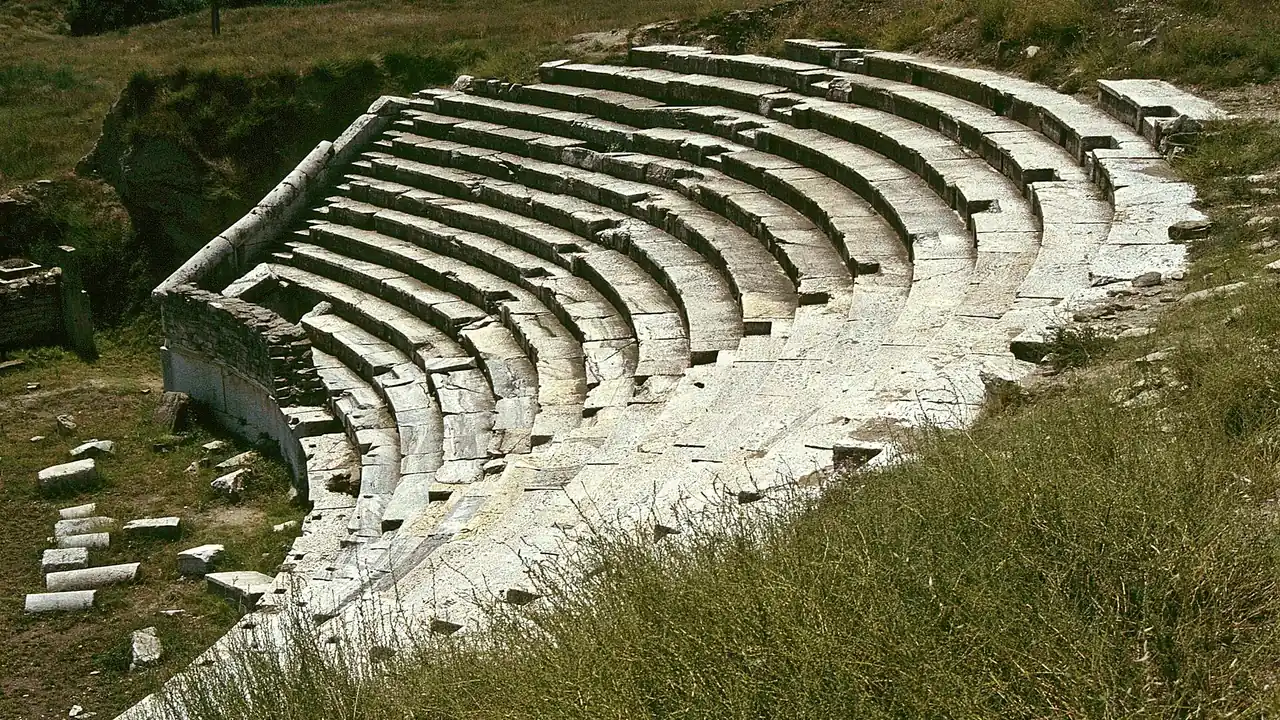
Stobi is the biggest and best excavated Roman city in North Macedonia: a whole street plan of basilicas, mansions, baths and a theatre spread over a terrace where the Crna river runs into the Vardar, 80 km south of Skopje and signposted straight off the motorway. Entry is 300 denars in summer, it opens daily from 08:00 to 19:00, and you need about two hours. One thing decides whether the visit is brilliant or flat: the site’s famous floor mosaics are covered up from November to April to protect them from the weather, so a winter ticket buys you walls and outlines, not peacocks.
That single fact is worth planning around, because the mosaics are what put Stobi ahead of every other classical site in the country. The peacock on your 10-denar banknote is a fragment of a floor lying here, in the baptistery of the Episcopal Basilica, and seeing the original a metre from your feet is a different thing from reading about it.
What Stobi was
The city started as a Paeonian settlement in the Archaic period, on a terrace above the confluence of the Erigon (Crna) and the Axios (Vardar) - the junction of the main route from the Danube down to the Aegean. That location made it rich, and it kept making it rich for eight centuries. Livy gives the first written mention in 197 BC, in connection with a victory of Philip V over the Dardani. Rome made it a municipium in 69 BC, after which it struck its own coins reading Municipium Stobensium, and its citizens held Ius Italicum, the top tier of provincial privilege.
By late antiquity Stobi was the capital of the province of Macedonia Salutaris (you’ll also see it written as Macedonia Secunda) and a serious church centre: its bishop Budius attended the First Council of Nicaea in 325, and Emperor Theodosius I stayed here in 388. The end came in stages rather than all at once. The Ostrogothic king Theodoric sacked the city in 479; the survivors rebuilt; an earthquake in 518 wrecked it again; then the Avar and Slav invasions of the 6th century finished off the trade that had held it together.
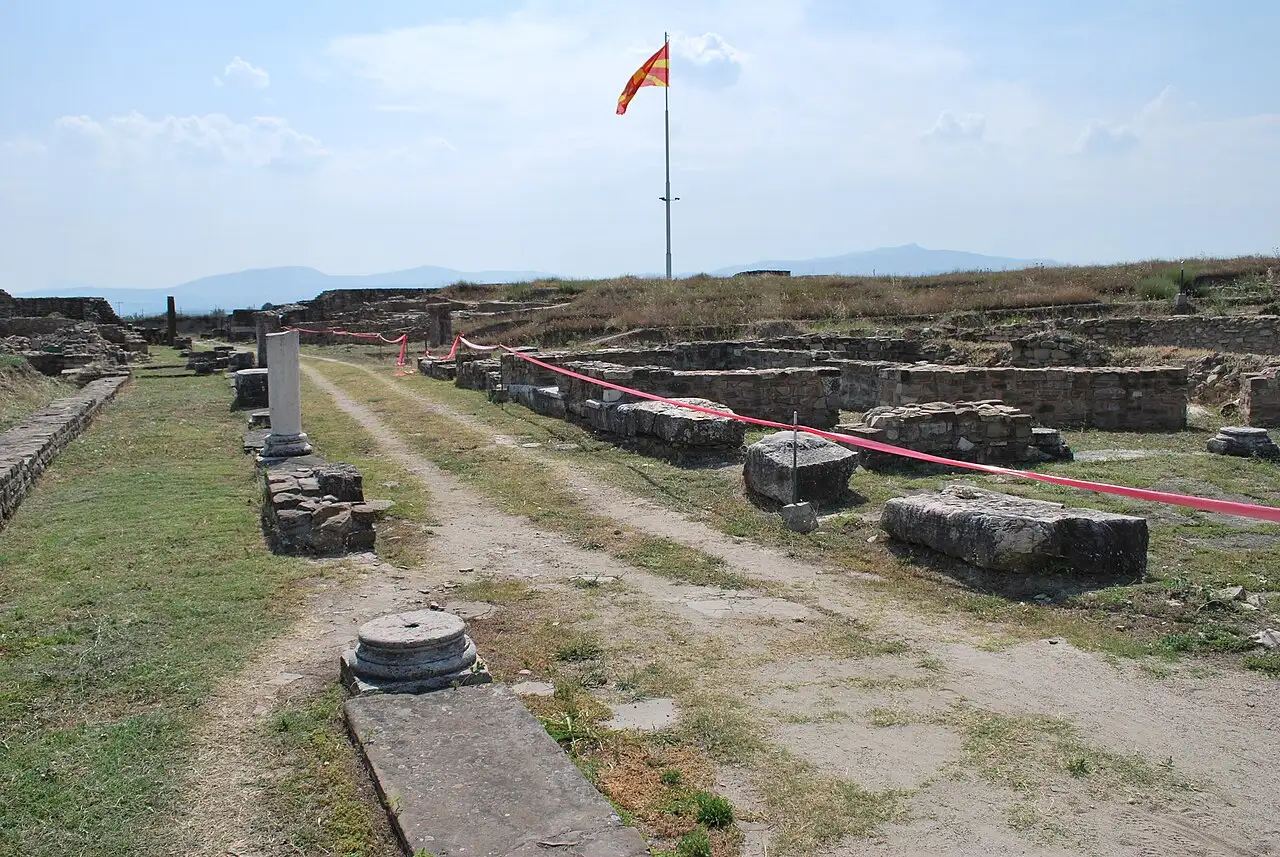
Walking the site: theatre, basilicas, houses
The official site map numbers 25 monuments, and they sit along real streets with real names: Via Sacra, Via Principalis Superior and Inferior, Via Theodosia, Via Axia. Follow them and the visit organises itself.
The theatre is the first thing most people photograph: a semicircle of stone seating for about 7,600 people, parts of it under long-running restoration. The official site dates the finished building, cavea and stage together, to the middle of the 2nd century, and its programme was never only drama - gladiatorial and venatio shows ran alongside mime and choral performances from the start. Two details on the stone say so better than any label. Family and individual names are cut into the seats, reserving places for the city’s prominent citizens. And the seats nearest the orchestra still carry the holes that held the posts of a safety net; after an earthquake at the end of the 3rd century the net was replaced by a solid wall and the central room of the stage building became a temple of Nemesis, the goddess of the arena.
Uphill stands the Episcopal Basilica with its baptistery, the richest single spot on the site. It has been dug at intervals since 1918, with the main modern campaign in 1981-1988. The baptismal font sits in a small round room, and the floor around it carries the peacock and deer mosaics that turn up on postcards, in textbooks and on the currency. Peacocks stood for resurrection in early Christian art, which is exactly why they belong in a baptistery.
What’s easy to miss is that you’re standing on two churches. The 4th-century basilica underneath, the oldest church in the country and possibly built by bishop Budius, wasn’t demolished: in the 5th century the builders raised high foundations, filled the old interior in and set the new basilica about four metres above it. The columns of that new church stand on a stylobate made of seats carried up from the theatre, which had gone out of use. The most impressive building on the site is quite literally made of the second most impressive one.
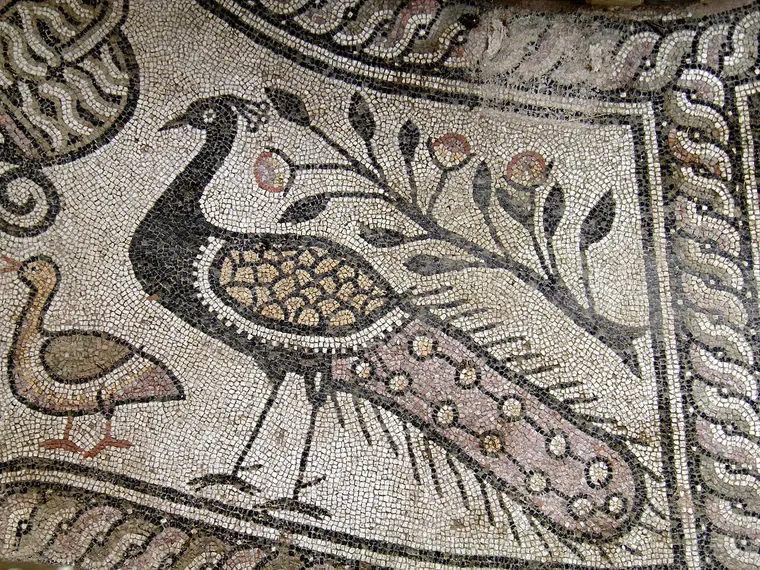
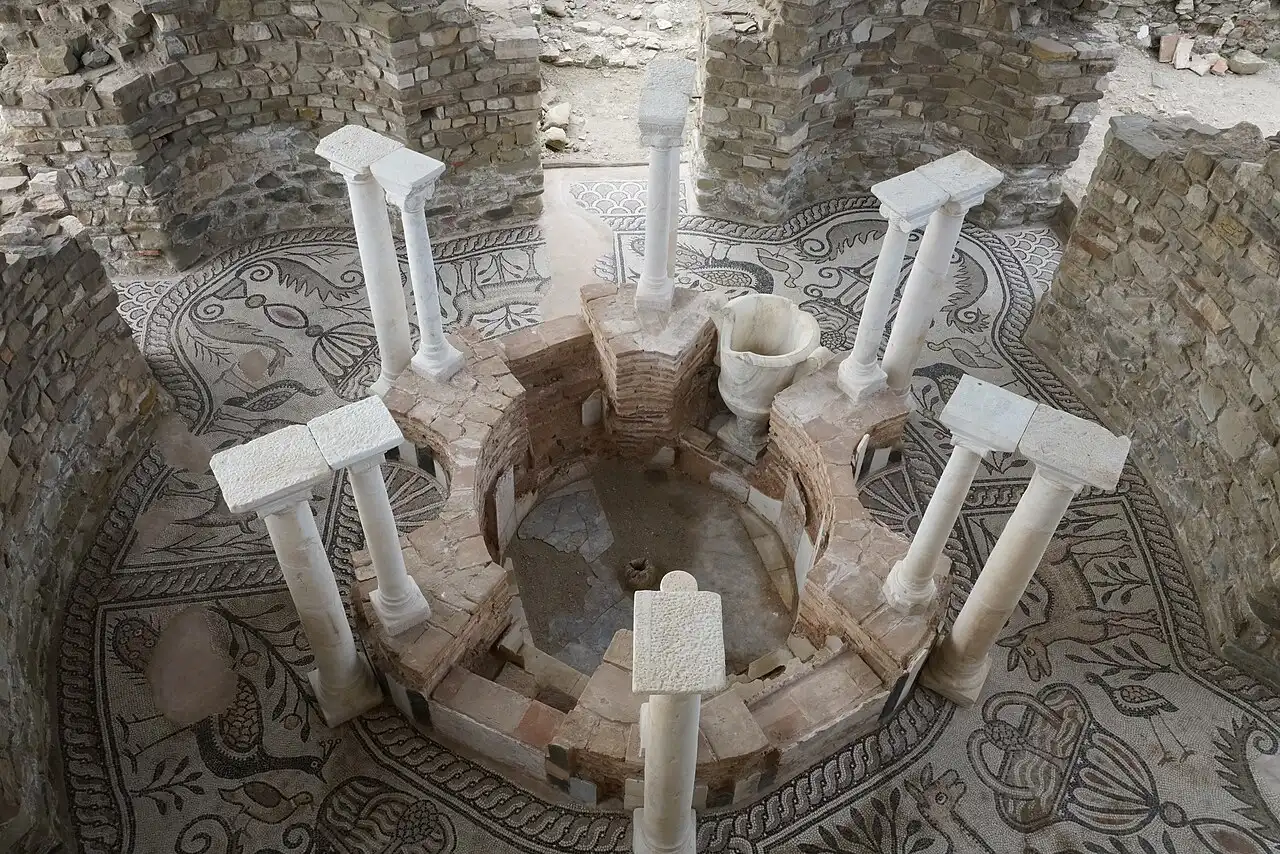
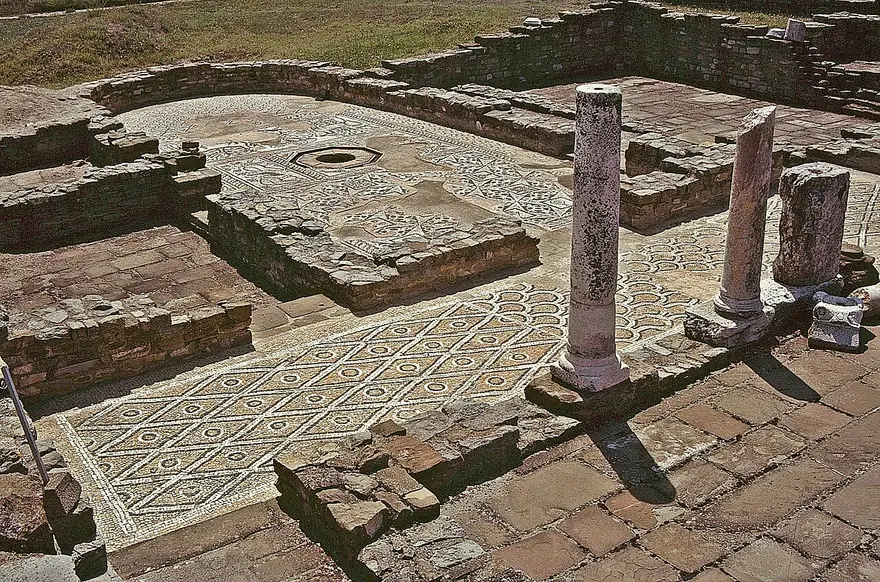
The private houses are the underrated part. The Theodosian Palace, the House of Peristerius and the House of Polycharmos (also called the House of Psalms) are late-antique mansions with mosaic floors, fountains and courtyards, and they say more about who actually lived here than any basilica does. The Large Bath shows its underfloor heating in the open: rows of small brick pillars that once held up a floor with hot air circulating beneath it.
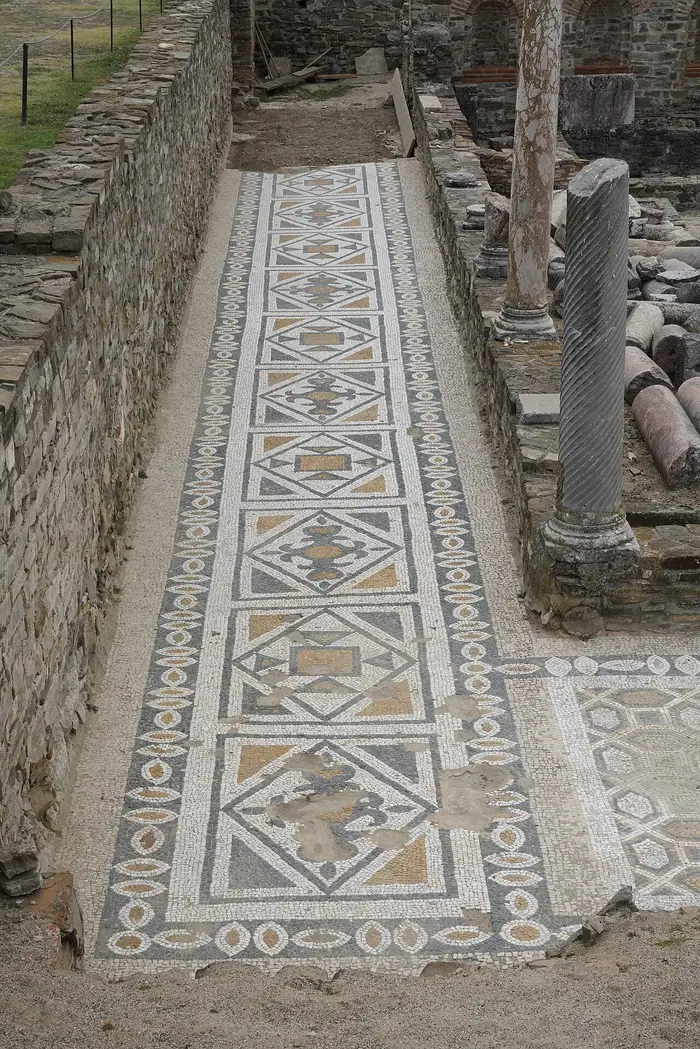
The building most visitors walk straight past is the Synagogue Basilica, and for layered history it’s the best thing on the site. Dig under its floor and you find two synagogues, one on top of the other: Synagogue I of the 2nd century AD, and Synagogue II of the late 3rd or early 4th, which had a menorah scratched into the wall plaster. A column found in 1931 records a Roman citizen, Tiberius Claudius Polycharmus, “father of the synagogue in Stobi”, who gave up part of his own house for it. The Christian basilica went up over the lot at the end of the 4th century. Two faiths and three buildings on one footprint, and almost nobody stops there.
Tickets, hours and the mosaic season
The numbers below come from the official site of NI Stobi (stobi.mk) and were checked in July 2026. Confirm before you travel.
| Ticket | 1 Apr - 31 Oct | 1 Nov - 31 Mar |
|---|---|---|
| Adult | 300 den | 250 den |
| Adult in a group of 10+ | 250 den | 200 den |
| Student | 90 den | 90 den |
| Child 6-18, pensioner | 60 den | 60 den |
| Under 6, ICOMOS/ICOM member | free | free |
At roughly 61.5 denars to the euro, a full adult ticket is about 5 EUR. The site is open every day 08:00 to 19:00, last entry 18:30. Live guides work 08:00 to 16:00; weekends and later slots need booking in advance on +389 75 210 752 or +389 43 251 088. There’s an official Stobi Audio Guide app for Android and iOS, which is the sensible fallback if you turn up unannounced, plus a paid “virtual experience” costing 300 denars on top of entry.
Free-entry days are worth knowing: the first Sunday of every month, 18 April, 18 May, the third Saturday of October and 23-26 September.
Then there’s the winter trap. Winter tickets are cheaper, and the site is empty and atmospheric in low sun, but the mosaics are covered from November to April, which removes the single best thing about Stobi. Pay the extra 50 denars and come between April and October. Inside that window, aim early or late in the day: this is a treeless terrace in the Vardar valley, and the official visitor rules tell you to bring a hat and water in summer for good reason.
Take that literally. Two hours on an open terrace with no trees is a lot of sun, food isn’t allowed on the site, and the facilities have been described as bare for years - the visitor centre that’s meant to fix that’s still a building site (see below). Bring your own water and a hat, use whatever is at the entrance before you start walking, and treat everything else as unconfirmed until the new centre opens.
A few other house rules catch people out: keep your fiscal receipt, no food on the site, no smoking, stay on the marked paths and off the walls and mosaics, and flying or filming with a drone needs permission from the Cultural Heritage Protection Office. The rule covers the filming, not only the take-off.
Getting to Stobi
Stobi sits 80 km from Skopje, immediately off the E-75 / A1 motorway running south towards Gevgelija and the Greek border, by the village of Gradsko. Official travel times are 55 minutes by car, about 1 hour 30 by bus and 1 hour 50 by train. Driving is by far the easiest, and the detour costs you roughly 90 minutes out of a Skopje-to-Ohrid or Skopje-to-Bitola day.
The site quotes those bus and train times but not where the services actually stop, and they don’t pull up at the ruins: check the stop in Gradsko locally before you commit, and budget for a taxi or a walk at the far end. Without a car, an organised day trip is usually the smaller headache. Our renting a car in North Macedonia guide covers hire, and getting around North Macedonia covers buses and trains.
One naming trap: Stobi Winery is a separate business, a modern winery opened in 2009 in Gradsko right next to the ruins and part of the Tikves wine region. A tasting there pairs neatly with an afternoon among the mosaics, and if wine is the real reason you’re heading south, see our Tikves wine guide and the Demir Kapija and Tikves wine road.
The 2026 upgrade
Stobi is mid-upgrade. The Ministry of Culture and Tourism is putting over 10 million denars into the site in 2026 for excavation, conservation and one visible change: the old railway station is being converted into a proper visitor centre, planned to open in September 2026. Treat that date as a plan rather than a promise, but it suggests the shade-and-facilities situation should be better than the bare kiosk visitors have described for years.
Set aside two hours, or three with a guide and the audio commentary. Stobi rewards slow walking more than most ruins do, because the point is the street plan and the floors rather than any one monument. For fitting it into a bigger trip, see our best day trips from Skopje and the 10-day North Macedonia itinerary, which runs right past the turning.
Read also
- Browse everything in attractions in North Macedonia
- Base yourself in the capital: things to do in Skopje
- Continue south into wine country: Demir Kapija and the Tikves wine road
- Driving the E-75: driving in North Macedonia
- Budget the trip: North Macedonia trip cost
Photos
On the map
The map loads on click - to keep the page lightweight.
The map didn’t load. Check your connection and refresh the page.
Admission and opening hours
- Admission price
- Adults 300 den (1 Apr - 31 Oct) / 250 den (1 Nov - 31 Mar); students 90 den; children 6-18 and pensioners 60 den; under 6 free. Groups over 10: 250 / 200 den.
- Opening hours
- Daily 08:00-19:00, last entry 18:30. Guides on site daily 08:00-16:00; later slots and weekends by prior booking
Prices and hours from the official site of NI Stobi (stobi.mk), checked July 2026 - confirm before travelling. The floor mosaics are covered from November to April. Free entry on the first Sunday of each month, 18 April, 18 May, the third Saturday of October and 23-26 September.
Details checked: July 23, 2026
Distance ≈80 km · ~55 min by car, ~1 h 30 min by bus, ~1 h 50 min by train
- Skopje ≈80 km · ~55 min by car, ~1 h 30 min by bus, ~1 h 50 min by train Signposted straight off the E-75 / A1 motorway between Skopje and Gevgelija.
Read also

What to see · 11 min read
Skopje Brutalist Architecture Walking Guide
Verified · September 3, 2026Walk Skopje's post-1963 concrete: Post Office, GTC, Tange's station and MoCA. Dates and architects from named sources.

What to see · 9 min read
Plaošnik & St Clement's: Ohrid's Sacred Hill
Updated · August 25, 2026Plaošnik in Ohrid: St Clement's church, early Christian mosaics and Slavic literacy's cradle - what to see, the walk up and looping Kaneo.

What to see · 9 min read
Skopje Museums: Archaeology to Mother Teresa
Updated · August 23, 2026Four Skopje museums worth an afternoon: archaeology, Mother Teresa, the Holocaust center and Macedonian Struggle - hours, tickets and how to visit.

What to see · 12 min read
Bigorski Monastery: The Carved Wonder of Western Macedonia
Updated · August 4, 2026Sveti Jovan Bigorski: the walnut iconostasis with 500+ carved figures, what the 2009 fire took, and how to get there from Skopje or Ohrid.